
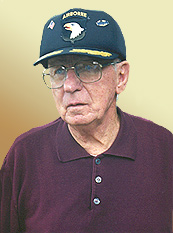

Fltr: Bob Lott -Carmen Gisi- Robert Bowen
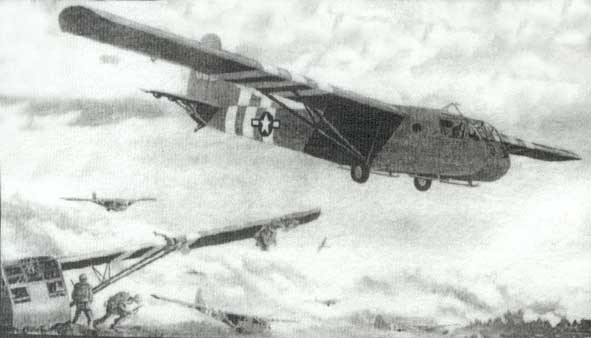
These three wwII veterans were back on Utah Beach for the first time since 1944. In the next pages I will show you some pictures from their tour through Europe in August 2002 and tell you something about the Glider Combat Infantry.
Brief History
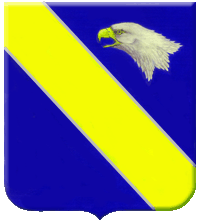
The 401st Infantry Regiment was constituted on March 12th, 1918 and never called to active service. June 24th, 1921 the regiment was assigned to the 101st Inf. Div. as organized reserves. Since the 101st Inf. Div. already had a basic structure, being carried as a paper division, it was chosen to become the second Airborne Division. The 401st was de-activated as a Infantry regiment on Aug. 15th, 1942 and re-activated on Aug. 16th, 1942 at Camp Claiborne, LA. as an Airborne Infantry Regiment. Which was to consist of two battalions that would land in gliders or by transport aircraft into a landing zone secured by paratroop forces.
The 401st would train at posts in the southern and southeastern United States including Ft. Bragg, SC. until July 1943 when they would be shipped to the embarkation area in New York. On Sept. 4th it shipped out to Liverpool, England.
In England the training continued with exercises BEAVER, TIGER, and EAGLE in preparation for the invasion of Europe. In March 1943, the 401st was separated. 1st battalion would stay with the 101st Ab but would be sent to the 327th GIR as the 3rd battalion. 2nd battalion would go to the 82nd Ab 325th GIR as the 3rd battalion.
For the invasion NEPTUNE, on June 6th 1944, the 1-401st would arrive on UTAH beach with the 4th Inf. Div. in UNCLE RED section. It was to link up with the paratroops that landed earlier that morning. Once the 1-401st was linked to 101st Ab it would aid in the attack and capture of St. Come-du-Mont on June 8th and Carentan on June 15th after 5 days of bitter combat. The 1-401st would also join the VII Corps on UTAH beach and the V Corps on OMAHA beach when they met forces of the 175th Reg. 4th Inf. Div. in the town of Auville-sur-le-Vey.
After 33 days of combat supporting VII Corps left flank the 1-401st was shipped back to England to recuperate the heavy loses of men and equipment they had suffered. For the next two months the 1-401st would train new men in glider landing techniques and be issued new uniforms and equipment. During this time all Allied airborne units were put under a new command known has the FIRST ALLIED AIRBORNE ARMY.
On
Sept. 17th, 1944 the 1-401st was again called into combat. This time they
would arrive in gliders. 933 glides were used by the 101st Ab for operation
MARKET-GARDEN with over 750 of these hitting the landing zone or were within
1 mile of it.
The 1-401st would fight for 72 days keeping the corridor open in the Son-Veghel
area of Holland for British XXX Corps. Fighting to keep it open was extremely
heavy. Once relieved, the 1-401st was sent to Mourmelon-le-Grand, France to
rest and fill it's ranks.
On
Dec 17th, 1944 the 1-401st was sent by truck to Bastogne, Belgium to aid in
its defense. The Germans had launched an all out attack in the area and a
veteran unit was needed to stop this assault. Glidermen were sent into combat
with what clothing and equipment had been issued them after the fighting in
Holland. Some went with out ammunition or winter clothing. The 1-401st set
up defensive positions in the area of Bastogne and beet back attack after
attack! It was through the lines of the 327th/401st GIR that the Germans came
to propose a surrender to 101st Ab Div. "NUTS" was the reply of
acting commander Gen McAuliffe!
The next day the cloud cover reseeded for a short time that allowed a supply
drop of parachutes with food, ammo, and medical supplies. Also in this drop
came gliders with heavy equipment, artillery and badly needed medical personal.
On Jan. 18th, 1945 the 1-401st was relieved and sent back to Mourmelon-le-Grand,
France.
In
late March 1945 the unit was sent into the Ruhr area in Germany.
Here they to capture Berchtesgaden, the mountain home of Adolf Hitler, and
aid in the mopping up remaining German forces. In Berchtesgaden the 1-401st
would stay until the end of the war.
Aug 1st the glider troopers were sent to Auxerre, France to train for the up coming invasion of Japan. Japan surrendered two weeks later and the mission was called off.
The
1-401st saw many changes in its short life and over came each and every one
of them. They fought hard in combat and helped to free the people of Europe
from German oppression. While doing so, men of the unit received numerous
battle field honors and lost many men doing it.
The 1-401st was also the recipient of Presidential unit citations, Battle
field streamers and decorations from counties they aided in liberating.
The motto for the 1-401st is "ALL FOR OUR COUNTRY". These men of the 1-401st proved themselves to be a vital part of airborne operations during WWII.
Normandy (with Arrowhead)
Rhineland (with Arrowhead)
Ardennes-Alsace
Central Europe
World War II distinctions:
Presidential Unit Citation (Army), Streamer embroidered NORMANDY
Presidential Unit Citation (Army), Streamer embroidered BASTOGNE
French Croix de Guerre with Palm, Streamer embroidered NORMANDY
Beligian Croix de Guerre with Palm, Streamer embroidered BASTOGNE
Belgian Fourragere
Netherlands Orange Lanyard
pages
1 - 2 - 3 - 4 - 5 - 6 - 7 - 8