Sergeant,
Chief Surgical Technician
of the Unit Headquarters
Co. 506th PIR,
101st Airborne.
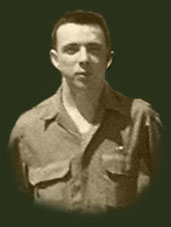
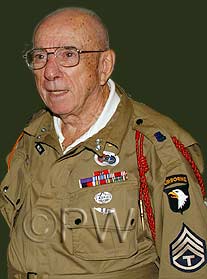
Paul's memories
were written by his granddaughter Lori A Straw.
Joe Miller, son of Paul R. Miller, did send the memories to Martijn van Haren
who gave them to me
Thanks to them Paul's story will be preserved for the future so that we will never forget that freedom is not free.
I worked at the Harrisburg Hospital on the Medical Ward, Ward
3, as a night charge for over a year. I decided to join the Army and not wait
to be drafted. I went to downtown Harrisburg and tried to enlist but found
out that my parents must sign my papers as they thought I was a little to
young. I returned to Bairdstown for my parents permission, which they reluctantly
gave and to get my birth certificate. It was then; I found that no certificate
was ever issued. Three ladies from the town who were there at my birth gave
affidavits that I was born and the good doctor also gave sworn affidavit of
my birth. I went back to Harrisburg, PA with the paper work and was ready
for my physical. They told me to pee in the bottle and after my physical they
said you’re in the Army now.
My request for the paratroops must have been mislaid as I was sent to New
Cumberland Army Depot for uniforms and two days later I was sent to Carlisle
War Barracks to the Medical Facility. They told me I was supposed to be in
the paratroops, not here so, they sent my back to New Cumberland. New Cumberland
then sent me directly to Walter Reed Hospital in Washington D.C. to train
as a medic because of my medical background.
The next day I was issued Whites and reported to the Officers Ward for assignment.
Needless to say I was the low man on the totem pole and a yard bird classification
which is also known as a buck ass private. The nurse assigned me the duty
of emptying the waste cans in all the rooms in the wing.
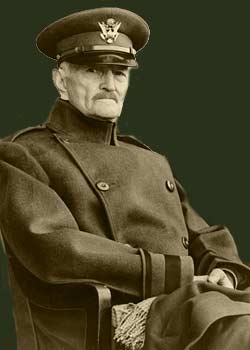
When I went into the one room, an elderly gentleman was lying on the bed and sat up to watch me. He asked what I was doing in his room and when I explained that the head nurse had assigned me this duty. He smiled and informed me that he had a Staff Sergeant in the morning and a Buck Sergeant at night to do these tasks for him. I left his room and reported to the head nurse. I thought she was going to drop over. She recovered and told me never to go in that suite of rooms again. She asked didn’t you know who was in there? I replied “No just some old man”. She continued to tell me that it was Blackjack Pershings, a General in WWI. So as a buck ass private and the first day on the job I had talked to the famous General Blackjack Pershing. In my book he was a soldier’s soldier. At night when the ward was quiet he would walk up and down the halls very quiet and with a military stride. Daily, I would report to the First Sergeant and request my transfer to the Paratroops and he would advise me that it has not come through yet. I took many courses there on First Aid, Iron Lung, Oxygen tents, Strokes Frame, etc. I met another soldier, James McNaughton and became fast friends. He also wanted to become a Paratrooper.
In the meantime while waiting, we met a wonderful woman, a
lady, Mrs. Ethel Le Carpentier who had opened her home to service men in her
house was just across the street from Walter Reed Hospital. Needless to say
we visited as often as we could. Mom Carpentier had two daughters one married
(Christine) and one single (Generve). Christine had a little baby girl (Susan)
who I dearly loved to hold and listen to her chatter. This refuge reminded
me so much of home and my little niece.
After
two months, I finally got tired of waiting for the First Sergeant to get action
on my transfer so, I wrote to the Commanding General of the Paratroops at
Fort Benning, Ga., asking him if I could be transferred into the paratroops.
Within a week, I was called into the First Sergeant’s office and he
read the riot act to me for not going through the proper chain of commands.
When he was done chewing me out, he sent me in to see the Major. After
two months, I finally got tired of waiting for the First Sergeant to get action
on my transfer so, I wrote to the Commanding General of the Paratroops at
Fort Benning, Ga., asking him if I could be transferred into the paratroops.
Within a week, I was called into the First Sergeant’s office and he
read the riot act to me for not going through the proper chain of commands.
When he was done chewing me out, he sent me in to see the Major.
As I stood at attention
and saluted he ignored me until some minutes later, he returned the salute
and advised me that he did not appreciate a buck private going over his head.
He then read what the Commanding General wrote. He was to transfer me to the
paratroops if I could pass the physical. The Major’s exact words “You
better pass that physical or your ass is mine the rest of the war”.
Needless to say he arraigned a top notch physical and when it was done they
had recorded everything from the tip of my head to the soles of my feet. I
knew if I had dandruff or flat feet I would not pass. But, I did pass and
my orders were cut.I
was shipped to Camp Toccoa, Ga where the 506 Parachute Infantry Regiment was
being organized. This was the first regiment ever to train as a regiment so
we all started out in the same place and time. The ride was by train to Toccoa
and G truck to camp. On the way to Camp Toccoa, we passed a coffin manufacturing
company, which didn’t feel good. The original place was called Camp
Tomb until Col. Sink changed it to Camp Toccoa
One night we stayed in tents and the next day I was in the Medical Detachment.
With my medical background there was hope for a line company and I was assigned
to Regimental Headquarters.
Several weeks went by
as our Regiment was filled to meet our quota plus a few more as men were rejected
or washed out in training. Physical exercise was extensive. Everyday we were
up at six or earlier ate breakfast, cleaned up and then exercised. We ran
the obstacle course and ran Currahee Mountain, three and half miles up and
three half miles down at least once a day but mostly twice We then had training
in hand to hand combat, judo, guns and ammo, and instruction in medical training.
We had lunch then continued more hand to hand combat, running to obstacle
course, dinner and sometimes more classes. In between all the strenuous exercise
we were helping at sick call. We double timed everywhere we went. Five, Ten,
and even 15 mile hikes were common. Jim McNaughton arrived and failed the
physical and was shipped
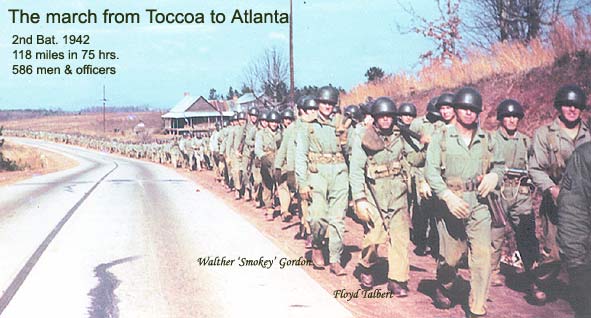
out. After weeks of this training it was decided that we were going to march
to Atlanta, GA in two stages and then be trucked to Fort Benning, GA where
we had more physical training. We were to march 115 miles in 3 days. We had
to prove we could march farther and faster than the Japanese. We broke the
record and became number one. Of
course, it was costly; we marched all day through rain, sleet and mud over
back roads and across fields with a break every hour. I tended many of blisters
on men’s feet and on the third day the feet of some men were raw; but
they kept going officers and men alike. I treated men with fever,
colds, and related illness and we kept going. At midway the other half took
over on the last lap to Fort Benning. Since some of our Medical Detachment
could not handle
all the injuries I was assigned to the second half also. We made the march
(above right) and we all felt proud. All of us were assigned Quonset huts
at Fort Benning with a
little stove in the middle that looked
like a tunnel turned upside down and burned wood. If we could find enough
fuel we could the chill off the hut if not it was cold.
Physical training
started again. We double timed everywhere we went. To jump training on the
mock-up towers to the release drops to chow and back to the hut.
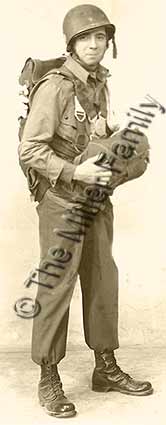
All of the 506th had to jump and pack our chutes five times
before we could get our wings. A few men dropped out for their own reasons
and were immediately shipped out. Then came the towers, we were hooked up
in the harness pulled two hundred and fifty feet with the opened parachute
over our heads and the sergeant on the ground would hit the automatic release
and we would float to the ground. On the second and third drops we had to
lay parallel to the ground when we were drawn up to the top of the towers.
Then facing down they would trip the release and down we would come. Of course
if we made a mistake or goofed on anything we were given a minimum of ten
from a leaning rest (push ups) but most of the time it was twenty-five.
Before we could jump from a plane we were tested on our physical strength
with a 200 point total to pass. This comprised of push up, chins obstacle
course runs in so many minutes etc. Some men had to try several days to make
the grade.
The morning came after some bad weather when we went to the packing shed where
we were taught to become riggers and packed our own chutes. The days following
were dragging and then the weather cleared and we put on our chutes climbed
into the C-47 planes and took off. Sitting in those metal bucket seats I guess
we all wondered if we would go out the door when the green light came on.
As we sat with our own thoughts I heard the jump master holler stand up, then
hook up, check equipment, and count off, than stand in the door. I guess everyone
kept looking at the red light and when it flashed green the jump masters
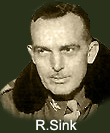
Our wings were pinned on by Commanding Officer Sink. (l) We
tucked our pants in our boots because we were now paratroopers. We felt cocky
and were ready for anyone.
We left Fort Benning to go to Camp McCall near Fort Bragg. We opened up this
camp. We stayed in primitive lodgings at that time. After several jumps there,
I was sent to Lawson General Hospital for further surgical training. After
graduating from there we went to Fort Campbell, KY for maneuvers and back
to Camp McCall. I was assigned to the demolition squad and we blew stumps
out of the swamp for a swimming hole. We were lucky it was cold because every
stump we blew had water moccasins under it. The cold water kept them inactive
and the explosives killed or stunned them. We were fortunate no one was bit.
Not too many men went swimming after that. We then were told to set up explosives
in trees and in shallow holes to simulate mines and incoming shells. Unfortunately
one of the demolition men had a premature explosion when he was hanging a
charge in a tree and it blew him off. I rushed to take care of him as he had
a gaping hole in his chest. I clamped off the bleeders put on compression
bandages as the ambulance arrived and rushed him to the dispensary and to
the hospital were he was pronounced dead. That was our first causality.
We left Camp McCall for our overseas furlough. We received a week’s pass and I flew from Raleigh N.C. to Pittsburgh and to Blairsville and home. My luggage was sent to another airport so I had only the clothes on my back for several days until my luggage caught up with me. I went over to the ration board and asked for a little gasoline to see my friends before I went overseas. They turned me down my friends came to my rescue and I had plenty of gas. (So much for the ration board) . I went back to Camp McCall and then to Fort Braggs for outfitting for overseas. I was supplied with all necessary medical and surgical supplies, gallons of ethyl alcohol, and morphine curettes by the case, surgical instruments, bandages, etc. As I was the Chief Surgical Technician, I supplied my men as they needed it so my store was many.
The trip by train from Fort Bragg to our port of embarkation in Camp Shanks, NY was inevitable. A part of the ethyl alcohol was put to good use with powdered lemonade and often a time there lemonade was discontinued. When we arrived at our POE we were confined no calls or leaves at this point. At the POE were confined no one in or out but two men in cover come to the orderly room and asked for Major Kent. I asked for ID and they showed me their gold badges. Major Kent seen them and had to have one of our boys guarded until we were aboard ship. It seems he had been issuing his own cashier’s checks. We loaded on to a British ship SS Samaria and left New York past the statue of Liberty and into the Atlantic Ocean where we met the Convey forming and we were on our way. The food aboard ship was awful and most of us bought candy bars and ate fresh baked bread only. One day laying on deck it was foggy and the ships were changing course every so often to avoid submarines when out of the fog came another ship directly at us, we watched fascinating as it came closer their bells started to ring and the ships started to swing away from each other and as they swerved we were so close the men on the other ship and us could converse in normal tones. I swear we could have shook hands or leaped from one boat to the other. We slept on the floor, on the tables and some in hammocks; we were jammed in so some of us took to top side and slept there. A day later we were told we were going to England. The next day we arrived in at the port and were put on the train. After hours of travel we arrived at Hungerford. Our head quarters were Sir Will’s estate in Littlecote. He was the maker of Wills Woodbine cigarettes. We were belated in Quonset huts with pot bellied stove fired monthly by coal. There were two to a barrack, almost enough to keep warm. Outside latrines and buckets were collected and used as fertilizer. Training became in earnest. Forced marches, physical exercise and all what a soldier must learn plus the many hours in the Dispensary treating cuts, bruises sickness, etc. We were preparing for the Invasion. We grabbed parachutes jumped when we could just to break the monotony. I received several passes and went to London visited the sights and watched for the buzz bombs and V2. One vacation in Scotland played golf on and excellent course with borrowed clubs and balls met some wonderful families there.
Back at Hungerford food was not the best. We had powdered eggs, powdered milk, SOS, and K-Rations. It didn’t take long for a few of us that hunted to have venison. We butchered the deer and buried the heads and hides we quartered the carcass and hung them high in the trees and late at night in a five gallon lard can french fried the chopped up pieces. To break the taste we would kill a ring neck and prepared it the same way. We had fresh trout from Sir Will’s hatchery until one night a concussion grenade was dropped in the pond. All of us paid dearly for that. The game keeper found the deer hides and heads when he counted this deer head and found them missing and a search of the barracks revealed nothing as we had the meat in the trees. We were told it was a death penalty if caught. Treated Colonel Sink for headaches upset stomachs etc. (Hangover). Fever rose and activity heightened. Orders were to give shots to all men in the Regiment so we were busy boiling and sharpening needles and giving shots for days.
The day before D-Day we were briefed on a night jump to jump into Normandy, France. We were taken to the airport marshalling area brief on our objectives, issued necessary supplies, food, water, etc. We chuted up but were called back to the marshalling area due to bad weather; the ships would not be able to land on the beaches. The invasion was on hold for 24 hours. Weather broke and we rechuted and climbed into the planes. Eisenhower waited on the air field until every single plane left. One of the demolition squad asked me to jump a bundle for him as he was overloaded so I latched it onto my harness rope. Things were quiet, some were joking, some prayed and others were going to the john. After a time of night flying, we crossed the English Channel to the coast of France and all hell broke loose. The noise inside the plane was enormous. The sound of 'ack' 'ack' and exploding anti- aircraft shells could be heard in the cabin. Pilots were getting frightened and put it to full throttle went to 300 – 350 feet before turning on the green light. Our orders were stand up, hook up, check equipment, and then stand in the door. Around 2am the green light came on and the jump masters said go and out we went into the darkness. When my chute opened I witnessed one of the most beautiful displays of fireworks I had ever seen. The anti aircraft shells were bursting with an orange color, tracer bullets of green and red walking across the sky, aircraft falling I flames and my mind saying “what the hell are you doing here”. You could hear enemy fire going through the chute. A lot of men lost their equipment during their jump due jumping so low and quick.
Major Richard Winters (l) a Commanding Officer in Co. E lost
all of his equipment except for his trench knife in which he kept in his boot.
Most of the men when they landed got guns and supplies from the ground, men
who got caught up in the trees, and the dead. I jumped into Normandy and landed
near St. Come du Mont. Since, I couldn’t see the ground I dropped the
bundle from the demolition squad member on my rope and when it slackened I
prepared myself for landing. This time I crossed my legs as we had been told
the Germans had put poles in the ground and stretched wire across the tops
of them for paratroops and gliders. I hit hard, rolled and snapped my quick
release button, got out of my chute and tried to stand and fell to the ground,
my legs wouldn’t hold me. I said “now what” in the middle
of the night, behind enemy lines and I can’t walk. A German appeared
out of the night and I thought I was a goner; a trooper appeared and took
care of the problem. I reached down and had blood on both knees. It felt sticky
so I put a bandage over both knees and kept going. It didn't take me long
to realize I was being shot at. I didn't understand because I couldn't see
anyone else. I looked down and saw the white edges of my bandages were showing.
I removed the bandages, dropped my pants and re bandaged my knees under my
pants. I then pulled my pants back up and realized what if I was shot while
my pants were down. The first injured soldier I came across was an American,
a pathfinder who had a broken leg, as I was setting it I recognized him as
a fellow worker whom I worked with at Harrisburg hospital before the war.
I wrapped him in his chute and kept going. I came across two more Germans
as three troopers came by and I was left to go again.
One injured soldier that I attended to was a German who was shot high in his
left shoulder, clean through. I felt he was human and also needed help. I
cleaned the wound, bandaged it, and gave him a shot of morphine. Just then
I heard a sound behind me. I used what we called a cricket and clicked once.
If you were a friendly you were supposed to click twice. I heard no click.
I turned and saw his bayonet was too close. The wounded German soldier spoke.
I am not sure what he said because I don’t speak German but he saved
my life, as they say tit for tat. I treated wounded as I came
across them one being First Sergeant Miller of Regiment Headquarters shot
through both legs. Another medic and I patched him up the best as we could.
He was a career man who had trained all his life for this event and was out
of action within minutes of the invasion.
After jumping into France some of our men were ordered to
secure enemy weapons of all sorts. So when we had a few vehicles several men
came in to a small campground where we were eating our K-rations with a 6x6
loaded with guns, mines, shells, etc. For some reason the truck with all the
Germans equipment exploded. There was little left. We took sacks and gathered
up all the parts of human remains we could find the biggest piece was about
four inches square. When a quick role call was held we knew who the men were
that was on the truck. As daylight started to enfold I came across Col. Sink
and four other soldiers, whom I thought could be his body guards, of the 506th.
Col. Sink was hurt. I was sure it was his ankle, but he wouldn’t let
anyone near it. We found a cart with wheels nearby. We loaded him up and the
other soldiers wheeled him. We headed towards the beach. Battles were all
over the place. Both injured and dead American and German soldiers were lying
around. I stayed with them treating wounded as they came in. Later Major Kent
and a few of us medics set up Reg. Aid station at a church in St. Come du
Mont and worked steady as wounded from both sides came in. It is amazing what
the human body can stand. It is more amazing the amount of pain some men can
tolerate. More times then it seemed possible it didn’t matter how bad
they were hurting they would say take care of my buddy first or that other
guy needs you more than me. I had used up all the EMT (Emergency Medical Tags)
I carried so had to look for bundles of medical equipment to restock my supplies.
All my morphine was gone as well as bandages, sulfa, etc. We were fortunate
two bundles were found nearby and supplies were replenished. When I caught
my breath and sat down I re-bandaged my knees and went of the morning event
thinking I could place where I landed by sighting a church staple to my right
and left in the early dawn. My eyes closed and I was asleep probably from
the tension but was awakened by and aid man a few minutes later with more
wounded. When the wounded was cared for, a call for help from the men fighting
toward the beach their aid man had been knocked out somehow and they had wounded
so I started out in the ditches along the road and met American soldiers coming
in from the beach with metal detectors, sweeping for mines in the ditches
I was crawling in.
Later we crossed the river and set up an aid station in Carentan, the town was in shambles. Within 20 minutes the aid station was filled. We went house to house fighting. Wounded piled up and we worked through the day and night. I worked almost 45 hours without sleep. Capt. Hull and Major Kent were doing the same. We took Benzadrine to keep us awake then had to take Blue dreams to relax so we could go to sleep. We performed minor surgery and some emergency major surgery. The house filled with wounded and to make room one of the men started to gather up the guns and put them in a closet when one of the sub machine guns went off and hit a wounded man in the leg. His only remark “You can even get shot in an aid station”. Minor wounds were cleaned, sulfa powder applied and bandaged. Captain Hull and I worked in on one man that had been machined gunned just above the knees. Captain Hull took over and tried to get an IV going but the patient’s vein collapsed and even with a cut down we couldn’t get any fluid into him and he just slowly became unconscious and died, probably from shock. Just then the aid men brought in a man on a stretcher, a man who was burnt. 3rd degree burns from head to his feet. The only place on his body that wasn’t affected was the soles of his feet, saved by the soles of his shoes. The only thing we could do was pore plasma over his body for any kind of relief. He had no pain but died a few hours later. He was a pilot of a light spotter plane that was shot down and burned. In Carentan, I was out scrounging for food and loot and thing the town was secured when I checked around corner in town and looked into the face of a German. Needless to say I pulled back as did the German. He took off his way and I mine. We had made contact with the beach. The town of Carentan was secured and we moved on to follow the Germans. One time, I was bringing medical supplies to a company aid man when I became involved in a bayonet charge across a swamp. Things were hot and I dove into the first hole I came too. It was a slit
trench the Germans used. After the firing calmed down I went back into the swamp to wash off and get rid of some of the smell. While going from fence row to fence row I was pinned down behind a large log and my wisdom tooth had been acting up and then it really hurt and tears came to my eyes and burned so bad that I couldn’t see. Bullets were hitting the log off and on and I hollered if had seen our dentist Capt. Fowler and somehow he got to me seen my problem and said he would have to pull it. As bad as it hurt I thought he was nuts we were in the middle of a battle. If anyone knew Shifty Fowler they knew he was fast and thorough. He said he was going to pull the tooth and that was an order and he done so. Almost at once the pressure left, my eyes cleared and Capt. Fowler took off in one direction and me another. It is hard to imagine the scene in an aid station when it is going full force. The battle see sawed back and forth with lulls at times. The men ate what they had and could scavenge. The recently killed cattle were used when time permitted. Col. Sink put out an order no shooting of live stock, a day later Major Kent invited Col. Sink over for supper. We managed to cut them down to steaks. Before Col. Sink took one bite he asked Major Kent if this animal was shot. Major Kent turned to me and asked the same question and I replied truthfully it had not been shot. They enjoyed there meal. I felt relieved no one asked about shrapnel from a hand grenade. I found it wise never lie to the Brass.
The sounds that the big shells made from the battle wagons, sounded like trains going overhead. The German 88 had a sound of its own as did the different weapons that each side used. One got to tell whether they were coming in close or going overhead out of your little domain. When mortars dropped in everyone was on their own. We had been pulled off the line and relieved. Trucks took us south in France. We dug in and climbed into our fox hole and fell asleep almost at once as we were well behind our lines. I half awoke when a single German plane went over high up. Its motor hard was almost out of hearing when I found myself lying several feet from my fox hole, not knowing what had happened I dove back into it. The next morning when daylight came there was a large crater, about 100 yards, had missed us by about 50 yards, when a bomb had hit and that’s what blew me out of the foxhole.
One evening I was asked to treat a woman and when I arrived at the basement where most of the civilian stayed I found a woman about to deliver. Well when no doctor is available you do the best you can. It was my first delivery. I treated many civilian for wounds of all kinds as well as sickness. One job was a chore when I had to debris a woman’s face that was badly encrusted with open sores. Later Doc Hull said it appeared to be cancer of the face. The poor woman had severe pain but was grateful for the treatment and bandage. Amputations occurred, sometimes they were completed by shells mortars or grenades, and there were a few times I had to complete the job when only a few muscles held the extremity on. That was not a problem it was stopping the bleeding and preventing shock.
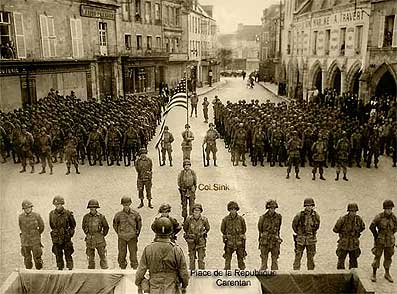
In Carentan, there was a short lull in the fighting and they held a little ceremony (left) in I guess the town square Col. Sink had just pinned medals on a few when the shelling started and that ended the first show of the 506th. I had a leave pass to Paris and I can say I seen everything from the sewers to the cathedral of Notre Dame. A trip to Pig Alley was enlightening the young women had hair dyed up to four colors. Beautiful well shaped girls doing acrobatics on hanging ropes they had no clothes on and the natives didn’t pay any attention but we soldiers did.
Finally, we were relieved
and we headed for the beach. We boarded LST I believe, and went back to England
and Hungerford and Sir Will’s estate. Training had been laxed but restored.Back
to Sir Wills estate more training and more chicken sh--. Discipline was at
a low and the order came out that a jeep with a flag on it would be going
through the compound with an officer, personnel and driver. Anyone who failed
to salute the officer was given a summary on the spot. This went on until
they tried it on First Sgt. Miller who was well
up on the A.R. (Army Regulations) he appealed to Colonel Sink requesting a
general court marshall. It was dismissed and there was no more jeep touring
the compound.
We were recruiting
any man that would enlist and jump five times to get their wings. There were
many wounded and as General Eisenhower said they anticipated 82% casualties,
we didn't miss it by far. Some of the men that were wounded and had been in
the hospital went AWOL and came back to the 506th and col. Sinkwas put to
the task of having them removed from the AWOL status to on duty in the 506th.
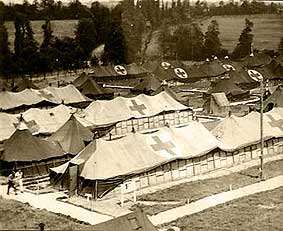
We found out what hospitals some of our medics were taken when injured. Some of the men were to be shipped back to the states and to be discharged. The ambulance driver and I gathered up their personal belongings and took them to the hospital, delivered them in person and bid them goodbye. The parting of good friends is hard but they were on there way home to their loved ones minus some body parts. Orders came to get ready and back to the marshalling area to be briefed on a jump into Holland under the command up General Sir Malcolm Montgomery. We boarded the planes and were off to Eindhoven, Holland. This time it was a day light jump. It was a beautiful day, hardly a cloud in the sky. We jumped into machine fire and landed in a huge open farmland. The field was covered in parachutes. We hurried out of our chute and ran to the area assigned to us. We dug foxholes and got in them. To this day the foxholes are still there and shrapnel can still be found. The good Dutch people were out with fresh milk from their spring house passing it out as we went by filling our canteens cups. This was the first fresh milk in over a year. Then the honeymoon was over. The 506th moved toward Eindhoven and captured the town after a surprising house to house, street to street fight. This was the first town to be liberated. The local Dutch people were out in force and helped dig out the hideaway German soldiers and not for them many of us would have been injured or killed. It was good to have a little break as our wounded was fewer than in Normandy. The activity picked up as we moved north to aid in the action in the ‘Bridge to Far’. We set up an aid station in a school. Major Kent ordered me to put a white bed sheet with a red cross painted with mercurochrome on the roof. Within minutes there was an explosion. We hit the floor then another explosion hit. A German shell almost hit the center of the cross came through the roof out the other side and partially exploded in the court yard. I was so close I picked up the shell and burnt my hands. It was still hot from the friction through the air and roof. How lucky can a man get? What would have happened if that shell had not been a partial dud? It took me three minutes to take down the Red Cross sign.
We expected to see General Montgomery come through with his tanks but he failed to show up on schedule, this resulted in a fight all the way up to the Arnhem and Nijmegen bridges. We moved up to the island in Arnhem under fire the Germans who had the high ground and we had the low ground. Life became a little better when a jam factory provided us with a desert. Some strange things happened during the war. In Holland not too far from the Jam factory we were pinned down for several days and I had run out of food. English ration so I found a few apples partially rotten and some onions in a garden they tasted like steak I was so hungry. How I smelt was another matter.
We liberated a woman’s baby factory where the German women produced babies for Hitler. When we moved the children and mothers out to behind the lines some of us thought it would be a good shelter as the Germans wouldn’t shoot at the building. That night we went to sleep in the attic, the men sleeping under the roof. During the night we heard a loud crash and not knowing what it was everyone remained in place and was very quiet. When dawn came and light filtered in, a shell had came through the end of the house grooved a path between our two lines of sleeping men and did not explode. We got out of there in a hurry. There are many accounts like this in a war and one wonder why these things happen. Many a man was saved when his pocked bible stopped a bullet or a piece of shrapnel.

WWII photos are courtesy the Miller family © and of the webmaster ©.
"Band of Brothers" & all related marks & media are TM &
© 2001 Dreamworks Television & HBO. This site is in no way affiliated
with any entity involved in the production of this film. All opinions contained
here in are not intended to infringe on any copyrights. For remarks or comments
please mail me.
Peter van de Wal ©
