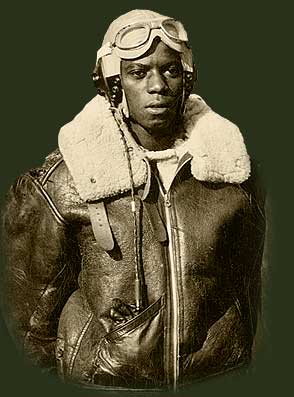
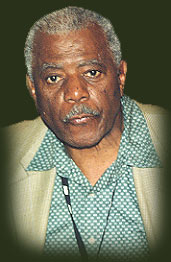

During the Easy reunion in Paris I had the privilege to have a short talk with Eugene J. Richardsons, one of the famous TUSKEGEE AIRMEN from the 99th fighter squad, 477th. He had a wonderful speech at the farewell dinner on June 7th.2001.
Americans had been flying combat aircraft for more than 30 years, since World War I. But before the Tuskegee Airmen, only white Americans flew these aircraft. A series of legislative moves on the part of congress made possible the activation of the all-black 99th Fighter Squadron on March 22, 1941, despite opposition on the part of the Army Air Corps and the War Department.
Tuskegee
Army Air Field, located at Tuskegee Institute in Alabama, became the training
center not only for the 99th but for all black fighter pilots during World
War II. The program expanded to include the all-black 332nd Fighter Group
and 447th Bombardment Group, requiring additional training facilities.
There were critics of the plan to put Black Americans into the cockpits of
combat aircraft during World War II, stating that Blacks would be incapable
of learning to fly, or would prove inept and be a liability in battle. "The
Tuskegee Airmen proved them wrong."
Eugene
Richardson became interested in flight as a young boy in 1930 when his father
and a friend took him along to see the Colored Air Circus, a group of Negro
aviators performing an air show in Mansfield, Ohio. Air shows or "air
circuses" were popular aviation events in the 1920s and 1930s. African
Americans had to organize their own air shows because of racial discrimination.
Most air shows included low-cost flights for spectators, most of whom had
never ridden in a plane or even seen a plane up close. Air circuses helped
remove obstacles by introducing planes and flying to African Americans and
by demonstrating that black people could be accomplished pilots. Driven by
pure interest to fly, he decide to join the Army Air Corps in order to become
a pilot. When he turned 17. he went to the Customs House at 2nd and Chestnut
here in Philadelphia where he signed up to take a pilot qualification test.
His father was actually against his decision to train as a pilot, but he eventually
gave his permission and signed the parental permission papers needed since
Richardson was still under age. He passed the test and a few months later
at the age of 18 he was sent to Keesler Field in Mississippi for 3 months
of basic training. From Keesler he went on to Tuskegee Army Air Field for
40 weeks of training( 10 weeks, of pro-flight. 10 weeks of primary. 10 weeks
of basic. 10 weeks of advanced) Tuskegee held
the civilian contract for pilot training for the Army Air Corps at that time
and had 42 Negro civilian instructors. White trainees went to different bases
for their 10-week training segments. The Negro aviators stayed at Tuskegee
for all 40 weeks. After Tuskegee. he went to Eglin for gunnery training and
then to Walterboro. SC for combat training. At Walterboro. Richardson learned
to fly P-40's and P-47 aircraft. While he and 37 others finished their flight
training in March 1945. the war ended in the European Theater just 2 months
later so they never saw any combat.
Richardson
is not sorry about that. " 1 didn't want to go kill anybody or get killed.
I just wanted to fly." Of the 38 pilots in his class.
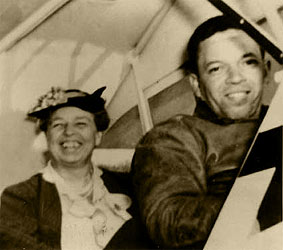
On a visit to the Tuskegee flying school, circa 1940, First Lady Eleanor Roosevelt flew with pilot C. Alfred “Chief” Anderson. Roosevelt’s willingness to fly with a black pilot had great symbolic value and brought visibility and support to Tuskegee’s pilot training program.
circa 1940
Smithsonian Institution, Neg. ID #: 90-7010
23 including Richardson graduated as fighter pilots and 15 as B-25 bomber pilots. His most memorable experiences as a pilot were his first solo flight, the first formation flight and the completion of his first simulated combat mission. He also recalled one flight during which he had to return to base immediately after takeoff because the oil temperature gauge pegged itself at over temp. It turned out that the engine had completely lost all its oil. Richardson got the plane, a P-47. back on the ground before the engine seized. During combat training at Walterboro. the pilots flew twice a day, even day, weather permitting. A typical training flight would last about 2 hours with about 30 minutes of pro-flight briefing and plane checkout before wheels-up heels-up. Dr. Richardson was discharged in July 1946. He returned to Philadelphia where he finished his high school degree at then Temple High School. Ho did his undergraduate work at Temple and got his Masters' and D.Ed at Perm State. He pursued a successful career in education in the Philadelphia School System. He did not pursue a career in Aviation after his discharge from the service because, "there was nowhere for a Black aviator to go in the United States - only Tuskegee."
An interesting anecdote: Richardson's son . Eugene Richardson III was also a fighter pilot. and is now the Boeing 777 Fleet Standards Manager with American Airlines. He is responsible for the training and certification of pilots for the 777. and all procedures for the aircraft in flying to airports throughout the world. In 2001 he flew the Band of Brothers veterans and actors to Paris on occasion of their reunion and world premieres of the TV-series.
Dr. Eugene Richardson resides in the West Mt. Airy section of Philadelphia and regularly visits schools telling the story of the Tuskegee Airmen.
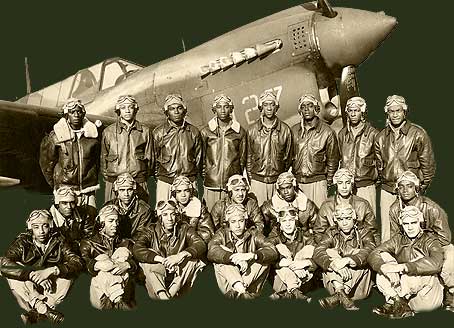
top
row l-r : Eugene J. Richardson,Jr.
- Spencer Robinson - Edgar Doswell - Wilbert Moffett - Robert Jones - Samuel
Broadnax - Harry Pruitt - John Burch
2nd row l-r: Clayo Rice - John Walker - Joseph Gash - Vincent
Campbell - Alfred Smith - Ernest Cabule - Bertrant Holbert
Bottom l-r: Harry Winston - Luzine Dickham - Edward Jenkins
- Clarence Finley - Thomas Morrison - Marsille Reed - William Coleman
They
never lost a bomber to enemy fighters.
"The armed forces were officially integregated in 1948.
It has taken 50 years for the Tuskegee Airmen to gain the recognition that
they deserve." The airmen, named after the Tuskegee Institute in Alabama,
which was near the airfield where they trained, were notable for their breaking
of racial barriers in the Army Air Corp (which is now the Air Force), but
have been involved in just about every American conflict -- from the Revolution
to Desert Storm.
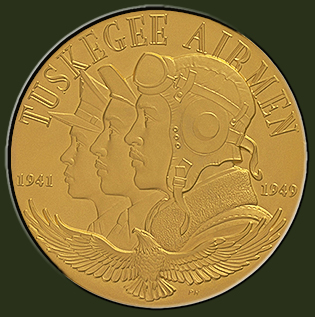
In 2007 Eugene and the other Tuskegee Airmen were awarded with the Congresional
Gold Medal.
Some statistics that you would not find in history books...
More than 10,000 blacks served during the American revolution.
During the Civil War, 171 black regiments were raised and 19 Medals of Honor were awarded.
Fourteen Medals of Honor were awarded to soldiers of the black regiments that fought in the Indian Wars.
The 10th Calvary regiment had actually captured San Jan Hill before Teddy Roosevelt's Rough Riders made their famous charge during the Spanish-American War.
link to a website about another Tuskegee Joseph P. Gomer
Here
a
video about Eugene Richardson jr
from 2020 when he was 94 years old..
Speech
from Dr. Eugene Richardson jr.
More information on this site about the Tuskegee airmen
with the complete
roster
from all pilots including Eugene Richardson jr.