D-Day: Former paratrooper carries memories,
scars of war to this day
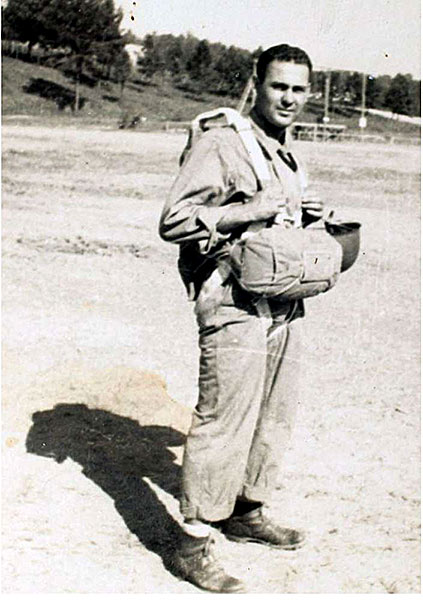
Army Pfc. Mario Patruno was 23, tough and fit. He'd fought in the ring as a youth boxer, and in the streets of Holyoke, Mass., with a brawling gang called the Bond Street Rovers.
On the dark morning of June 6, 1944, he'd need all the toughness he possessed if he wanted to see June 7.
Flying over Normandy under heavy fire, his plane was going low and too fast when he jumped from 400 feet, landing far from his intended landing spot.
His parachute riddled with holes, he tumbled to a rough landing, all alone.
It was 1:20 a.m. on D-Day. Patruno — nicknamed Gus — was a member of Company F of the Army's 506th Parachute Infantry Regiment.
His job: to help hold a causeway at Utah Beach.
In the confusion, he never made it to the causeway, but for the next month he would endure a series of skirmishes and firefights across France — bloody, nasty moments that still cause him to cry out at night.
Now 93, he lives with his wife Ruth in a senior community.
The exact order of the days after D-Day are a little fuzzy for him today, but his memories of specific events are vivid.
Focused on survival
He was born April 8, 1921, in Massachusetts to Italian immigrants. After World War II started, a recruiter sold him on the paratroopers.
"He said, 'We got this new outfit: You don't walk, you ride in planes, it pays 100 bucks a month.' I said, 'Sign me up.'"
In 1943, the 506th arrived in England to prepare for the invasion of Europe.
Before it came, there was some time for sightseeing.
Patruno was cheeky: He once tried to take an ancient brick from Roman ruins in Wales, but the authorities stopped him.
"I told them I was Italian, I was related to Julius Caesar," he said. They didn't buy it.
Rumors and stories flew in the weeks before D-Day. He knew it was going to be big. Patruno remembers what a beautiful sight it was late at night, flying low over hundreds of ships making their way across the English Channel.
His gun stock was broken, but Patruno repaired it with medical tape.
Within half an hour, they stumbled on a lieutenant from the 82nd Airborne and about 15 men.
They joined up with them as they marched toward Utah Beach, but Patruno split off as the group from the 82nd went their own way. He was itching to join his own men.
The area was thick with Germans, and all his senses were focused on survival.
"Every bush was a German, every sound. You were on pins and needles," he said. "If you touched me, you were dead."
Outside a village, he stopped a Frenchman on a bike and asked him for directions. The local was reluctant to answer, and the reason became clear as three truckloads of Germans came over a hill. Patruno dived into hedgerows as the Frenchman tried to stop the Germans, frantically pointing to the Yank's hiding place. The trucks kept going, though, bound for someplace more important.
A little later, Patruno saw the Frenchmen, still riding his bicycle. He aimed at him and shot him, he says, right off the bike. He doesn't know if he was dead, but he knows the bike ended up in a ditch.
Early the next morning, or the one after that, he spotted five beautiful horses in a field next to a barn. He sneaked into the barn, which was guarded by two Germans. He stealthily took down a bridle, went back outside and chose the most beautiful horse. It was huge. It was white.
He couldn't mount the horse — not with a bag of grenades and his heavy pack — so he coaxed it over to a water trough, stood on top, and heaved himself up.
Just before dawn, he and the horse sauntered by a couple of German soldiers who waved hello to him.
He waved back. In the dark, they couldn't quite see what uniform he had on. Besides, what would a Yank be doing riding by on a big white horse?
And he was riding his white horse when he caught up with the men of Company F. It was quite the entrance.
"They said: 'Patruno, what are you doing? Hey Gus, there's a war going on.'"
Tommy's final words
Almost
seven decades later, Patruno tears up repeatedly as he speaks of his buddy
Tommy Wolford, a corporal who'd been with him since their training days
in the States. Patruno was at his side in Normandy as Wolford raised his
grenade launcher against an approaching tank.
"I'll get that tank," he told Patruno.
Those were his last words.
As the tank fired, Patruno jumped into a shallow foxhole, then shot and
wounded a German who approached his hiding spot. The man fell on top of
Patruno, coating him in blood. As Patruno struggled to get out from under
him, two unarmed German medics came to collect their comrade.
Patruno had no problems with that — at least not until the medics, whom
he held at rifle-point, loaded him on to a stretcher and carted him out
of the busy firefight.
Patruno later went back to find Wolford. His friend was lying there, his
arms underneath him, his face peaceful, with a smile on his face. Not
a mark on him. It may have been the blast concussion that killed him.
The war lives in him.
These days, Patruno speaks frankly of the terrible things he saw and the
terrible things he had to do.
"We had it drilled into our minds to kill those Nazis," he said.
"We had a saying: Come face to face with the enemy, kill him, eat
his rations and take his watch for a souvenir."
He once took the ring off the rotting finger of a giant German soldier,
dead on the side of the road. Another time he took a hunk of black bread
from another dead German's knapsack: The bullet that killed him had gone
through his chest, out his back and finally stopped in the bread. Patruno
said he ate the loaf, then spat the bullet out.
Orders were to take no prisoners, he said, so soldiers on both sides routinely
killed them instead.
"My friends, they gave their prisoners cigarettes first. I never
gave my prisoners a cigarette. I didn't smoke, and it was bad for their
health."
Once, though, as hardened as he was, he just couldn't pull the trigger.
The German was an older man, perhaps 45, half-balding. He held his hands
at his side and bowed his head as he prayed loudly, waiting for the bullet.
"He looked like my father!" Patruno exclaimed. "Like my
father. So I turned around and walked away."
In September 1944, Patruno would be among the waves of paratroopers dropping
into the Netherlands in Operation Market Garden, a bloody operation that
ended his war. A ricocheting bullet hit him in the face, breaking some
teeth and lodging in his tonsils.
The scar is with him still, and so is the war; he sometimes cries out
in his sleep, his wife says — not actual words, just moans and groans.
"Anything you see in the movies, he said, it was worse," Ruth
Patruno said.
After the war he worked in a wire factory back home in Holyoke, became
a brick mason, had six children and moved to St. Augustine in 1986 to
raise horses.
In 2004, at 83, he parachuted again during a reunion with his surviving
comrades in Toccoa, Ga., where they had trained. And in 2006, Patruno
went back to Normandy one last time. He found the grave of Tommy Wolford
and knelt down next to the marker honoring his old friend, who had looked
so peaceful after he died.
By Matt Soergel
Mario Joseph Patruno, a WWII Veteran and a “Screaming Eagle” paratrooper with the 101st Airborne “Soared with the Eagles” March 10, 2015, at the Bailey Center. He was born in 1921 in Holyoke, Mass., and would have been 94 years of age on April 8.
Mario was a member of: St. Pauls Episcopal Church, Federal Point, Fla., the 101st Airborne Association, Coquina Crossing Veterans, American Legion Alton Green Memorial Post 194, The Disabled Veterans Association, The Veterans of Foreign Wars, The Purple Heart Association, and 101st Chapters in Jacksonville.
He was with the “F” (Fox) Company of the 506 Parachute Infantry Regiment (PIR) and the 2nd Battalion of the 101st Airborne. A recent book tells the story of the “Fighting Fox Company,” The Battling Flank of the “Band of Brothers.” Mario was among 23,000 allied paratroopers who jumped into Normandy on D-Day in 1944, behind enemy lines, to secure the bridges and causeways. The 7,000-ship invasion began at dawn. He was among 40,000 allied paratroopers who jumped into Holland, in September of 1944. (The “Market-Garden” Operation) “The Liberation of Holland”.
Mario was wounded in Nijmegen and Normandy. He received the following medals: Parachute Wings with two stars, two Purple Hearts, Combat Infantry Badge, WWII Victory Ribbon, Presidential Unit Citation with Oak Leaf Cluster, Campaign Ribbon with 3 Bronze Stars and 2 Spearheads, French Croix de Guerre and Netherlands Orange Lanyard-Bronze Star Medal.
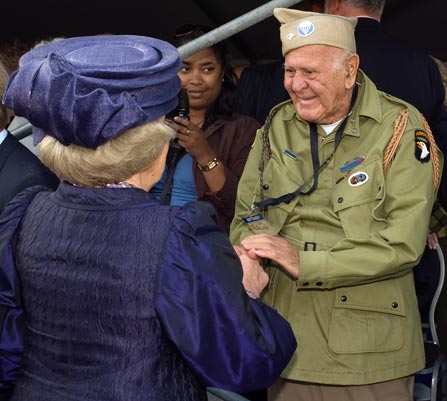
Mario loved his country, the military, and the American Flag and was proud of his service and uniform. He participated in “Massing of the Colors” on Memorial Day, proudly carrying the 101st banner with his friend, Jim Robinson. Among the highlights of his life, he was greeted by Queen Beatrix of the Netherlands during their 65th Anniversary of Liberation in 2009, and when he and his wife were guests of the Royal Dutch Army in 2014 for the 70th Anniversary of Liberation. Let’s not forget the solider on the white horse on Veteran’s Day at Francis Field in 2011! That was Mario. It was one of the best days of his life.
Mario is survived by his devoted wife, Ruth, of 38 years; his brother Dominic, sons Richard, Danny, Michael, and Dennis; daughters Linda Tefft, Dinah Thomas, six grandchildren and nine great-grandchildren.
He loved children, animals, and gave to those in need. Mario will certainly be missed by all who knew him.
Happy Trails, Mario. Let’s not forget our Veterans! Freedom is not free!
A visitation will be from 2-3 p.m. Saturday, March 21, with funeral services beginning at 3 p.m. at Craig Funeral Home. The inurnment will be held at 11 a.m. Monday, March 23 at Jacksonville National Cemetery.
In lieu of flowers, the family asks donations be made to a Humane Society of your choice or to the Wounded Warriors Project, 4899 Belfort Rd., Suite 300, Jacksonville, FL 32256.
Craig Funeral Home Crematory and Memorial Park is in charge of arrangements.
The St. Augustine Record, 03/15/15
