

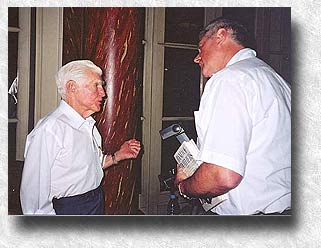
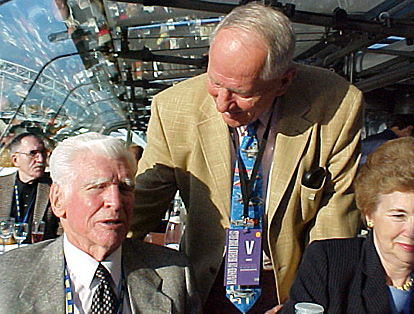
The photo on the left I made at the farewell dinner in Paris June 7th.2001 while Carwood held his wonderful speech for all the guests. He asked everybody to be seated, except the Easy veterans. It was a memorable moment for all of us.....
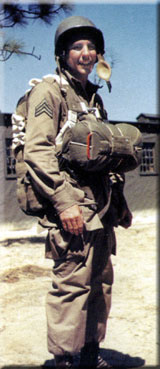
C.Carwood Lipton was
born in a poor family. His father died young in a car accident.
After reading an article in Life magazine he joined the paratroopers in
Toccoa in 1942 for the basic training.
As you can see in one of the first episodes from the TV-series, Carwood
was one of the Easy sergeants who refused to serve with Col.Sobel.
All the sergeants wrote a personal resignation and Lipton delivered them
at Sobel's office. Col.Sink called it mutiny and was 'pissed off'.
Though he replaced Sobel and Winters came back as a commanding officer.
It proved the brotherhood and special bond between Winters and the men
of Easy Company.
On there way to France
(D-day) Lipton was the jumpmaster in the C-47 Dakota. He had the pilot's
permission to decide whether the door should be open or closed. He decided
it would stay open during the flight, so the men could leave at once in
case of emergency.
Lying on his belly on the floor with his head outside the door, he could
see the amazing fleet in the Channel on the way to France. A view nobody
would ever forget in his life.
Lipton was one of the 12 paratroopers that eliminated the 4 German 105
mm guns at Brécourt Manor. He received the Bronze Star.
He was also involved in the fighting for Carentan.
According to the men
of Easy it was Lipton who managed to keep the group together in difficult
times. He watched over Easy Company since Winters became the commanding
officer. As you can see in episode 7 of the TV-series Lipton kept once
head cool during the time the commanding officer Lt. Dike (nickname Foxhole
Norman) did not take his responsibility.
Winters: "An Officer proves himself not being a bad Officer by taking
the wrong decisions, but by taking no decisions."
After W.W.II Lipton went into business and became the European director
from a glass industry. In 1983 he retired and bought himself a house in
Southern Pines, North Carolina.
He visited the reunions of Easy Company frequently. I couldn't imagine
that the first time I met Carwood in Normandy, June 6th.2001, would be
my last time.
I was looking forward to the next reunion in Phoenix (2002) but Carwood
passed away on Dec.16, 2001. He left behind his wife Marie, three sons,
five grand children and one grand grand child.
Carwood was the second "Band of Brothers" alumn to pass on since the miniseries
started. "Moose" Heyliger passed away on November 4th, the day of the
last episode. J.D. Henderson passed away on Febr.16th. 2002.
THE FIGHTING OF CARENTAN
C. Carwood Lipton E Company, 506th Parachute Infantry Regiment.
Following the first days of successful fighting in Normandy the capture of the city of Carentan at the base of the Cotentin peninsula and the linking up of the forces from the Utah Beach jump and the landings and those from the Omaha Beach landings assumed major importance. E Company on June 9th, D plus 3, had moved into a defensive line, part of a three-regiment front, facing Carentan from the North and occupying positions that had been prepared by the Germans. As we were on higher ground we looked down toward Carentan, something over a mile away. The Germans had prepared the positions with their usual thoroughness with well-dug foxholes and gun emplacement. I moved into the CP of the unit in the 3rd platoon sector, where there were still blankets and other gear and even German black bread and tins of butter. In the CP I found an artillery or mortar range chart showing ranges and azimuths for the potential targets to the front and an optical range-finder, both of which I sent to Company. It is interesting that the German positions were facing Carentan,
which
means that they expected the invasion to come from the direction of Le
Havre rather than from the peninsula. Although the Regiment had been engaged
in heavy fighting, particularly in clearing St. Come-du-Mont, E Company
had not been committed following the attack on the 88's on D-Day and some
skirmishing in the vicinity of Angoville-au-Plaine on D plus 1.
We were also building up Company strength as more of our scattered jumpers
rejoined us. I remember Buck Taylor, Guth, Talbert, Gordon, and Mellet
in particular as some who joined us here. I don't remember any officers
in the 3rd platoon in Normandy. Lt. Schmitz did not make the jump, and
Lt. Mathews was killed early in the fighting, so I had command of the
platoon. I set up outpost positions in the fields toward Carentan and
patrolled the area to our front, visiting the outposts with Talbert or
Taylor each night we were there.
There was no enemy activity against us, however, while we were there.
From the heavy, frequent gunfire nearer Carentan along the highway leading
into the city from our right and from the area East of the city to our
left front, beginning the night of the 9th, we knew that fighting to take
it was underway.
We maintained our positions, however, while the fighting in those areas
continued over the next two days. Our part in the attack began on June
11th, D plus 5, when we were ordered to move out with the rest of the
Battalion to the highway and, attacking to the right of it, to outflank
Carentan from the West and South. This attack would cut the two highways
leading into Carentan from those directions and a railway.We moved out
to the highway after dark and began our approach march with other units
of the Regiment leading. When we were stopped one time just as we reached
the bridge across the river before Carentan, while some Germans were being
cleared out by our forward units and the air was filled with the sound
of gunfire, I walked over to one of our men and asked him if he knew that
over 120,000 rounds were fired for each man killed in combat. I had read
that somewhere, and it seemed a good way to ease the tension, although
it sounds asinine now. There had been major fighting over the route we
were following. The area was strewn with bodies, American and German,
weapons and equipment, difficult to see clearly in the dark. We knew nothing
about what to expect ahead of us, but we were not at that time receiving
enemy fire.
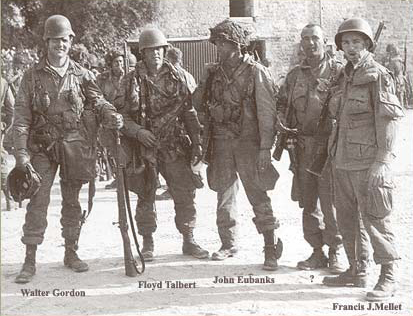
We moved in column, well spread out, with connecting files maintaining
contact between units. Suddenly I realized that we had lost contact with
the column ahead of us. Our column had stopped, and the officers in front
-with Lt. Col. Strayer, I think- were trying over and over to contact
the column ahead of us by radio.
I knew we would not be able to find our way to our objective in the dark
and over the strange terrain on our own, and that we were strung out in
a defenseless formation. The radio attempts were in muffled undertones,
and all our movements had been made as quietly as possible.
A German MG42 opened up with several short bursts somewhere off to our
left, and, expecting a possible attack, I moved over to one of our 3rd
platoon machine gunners and whispered to him to set up his gun facing
that direction.
As I moved quietly off to organize the rest of the platoon I almost jumped
out of my skin when my machine gunner full-loaded his gun. The sound of
an LMG being full-loaded, two times pulling back and releasing the bolt,
can be heard a half-mile away on a still night, and I saw all our attempts
at being quiet and surprising the Germans gone for nothing. There was
no attack against us, however.
After 10 or 15 very long minutes Battalion regained contact with the column
ahead, and we moved out again. We reached the railroad and, as I remember,
stopped there for a while, beginning to set up a defense, but then moved
out again to occupy the road leading into Carentan from the South. We
reached it after daylight and were told that we were to prevent any German
reinforcements from being brought into Carentan along it.
I don't know the disposition of the rest of the Company or the Battalion,
but the 3rd platoon was astride a road, which could have been a smaller
connecting road instead of the main highway. I had one bazooka in the
3rd platoon and Tipper was the bazooka-man. We were told to expect German
armor, and the only place I could find to put Tipper and his bazooka was
at the bend in the road down over a bank from where he would find it almost
impossible to withdraw if we were overrun.
As he and I looked at it I knew that he was seeing that it was a do-or-die
situation, but that there was not another good position.
I said, "Tipper, we're depending on you. Don't miss." He said, "I won't."
After a short time,
though, less than an hour as I remember, we were again ordered to move,
this time to attack and clear Carentan. As we reached the outskirts of
Carentan we started getting German rifle and machine gun fire. The houses
in this area were somewhat like row houses except that there were enclosed
stairways leading up to the second floors from the outside. I thought
that we were getting sniper fire from one of the upstairs windows.
Buck Taylor and I were working as a team at this point, checking and clearing
the buildings and area as went, so I told him that I would go up the stairway
to that room and that after he had given me enough time to get to the
top he should throw a grenade through the upstairs window. I would then
jump into the room and finish off whoever was there. I ran up the steps
and stopped outside the door.
I heard the grenade thump into the room through the window and its explosion.
I threw open the door and leaped into the room, my rifle thrust forward
ready to fire. I couldn't see a thing! The room was filled with dust and
smoke from the explosion.
If there had been a sniper there and he had been able to shield himself
from the grenade he would have had me silhouetted in the door, but the
room was empty. We continued to check buildings and work our way toward
the town center. The rifle and machine gun fire against us seemed to decrease
somewhat as we moved farther in , but mortar and artillery fire increased.
Men were getting hit. Someone yelled that Tipper was hit across the street
from me. I ran over. He was lying there conscious but hurt seriously.
A medic was bandaging his face and his eye was obviously gone. He had major wounds in on arm and one leg. I told him he would be well taken care of and moved on.
I came to a major
road intersection, nearer the town center.
There was small arms and machine gun fire coming down the street from
the right, across my front. Across on the other side of that street, on
the continuation of the street I was standing on, were several E Company
men. There were explosions up on the walls of the buildings on the left
side of the street that they were on, and they looked to me like German
5cm mortar shells fired at a low trajectory so that they were coming in
somewhat horizontally rather than dropping in vertically.
I was on the right side of the street I was on, against a building on
my right, and I did not think that the fire could get to me, but I started
yelling to the men on the other side to move farther along. I thought
that in the noise and confusion they might not realize that mortar fire
was being directed at them. I the middle of my yell a mortar shell dropping
vertically, a 5cm I believe, landed about 8 feet in front of me, putting
shell fragments in my left cheek, my right wrist, and my right leg at
the crotch.
I can still hear
my rifle clattering to the street as it dropped out of my right hand when
it was hit. It didn't knock me off my feet, but I dropped to the street
to check how badly I was hit. I put my left hand up to my cheek and felt
quite a hole. At first my big concern was my right hand as blood was pumping
out in spurts.
Talbert was the first one to me, and my first words were, "Put a tourniquet
on that arm." The tourniquet checked the bleeding.
I felt the pain in my crotch, and when I reached down my hand came away
bloody. "Talbert, I may be hit bad", I said. He slit my pants leg up with
a knife, took a look, and said, "You're okay". What a relief that was.
The two shell fragments
there had gone into the top of my leg and had missed everything important.
Talbert threw me over his shoulder and carried me into the barn nearby
that was being set up as an aid station. There I was bandaged up and given
a shot of morphine, which knocked me out completely.
When I woke up it was dark. They put me in an ambulance with another man whose shoulder was practically gone. He died on the way to Utah Beach, where I went into a tented field hospital for the rest of the night.
The next morning
I was taken on an amphibious truck out to LST 512. Its ramp was down,
and when the truck reached it, it drove right up the ramp into the LST,
which took me to Southhampton, England.
From there I was taken to a US Army Hospital in England for a six-week
stay before rejoining E Company at Aldbourne.
I have been back
to Carentan two times since the war, the first time in 1964 and the last
time in 1986. The road North of the city along which we held our defensive
position for three days still looks the same.
It is little more than a lane, and the chateau that marked the left flank
of the third platoon is still there.
Carentan itself is much the same as much as I can remember of it from
the first short time that I was there. I have some photographs of the
lane and some 3rd platooners, taken, I think, by Guth.
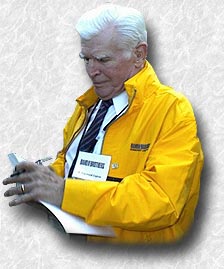
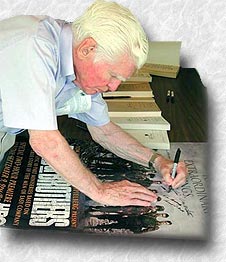
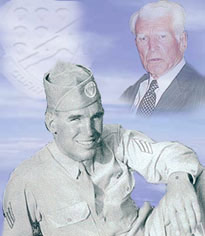
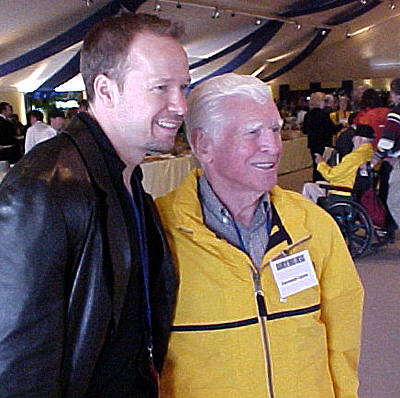
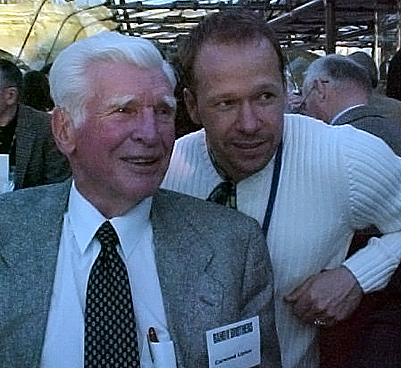
C.Carwood Lipton with Donnie Wahlberg, the actor who portrays him in Band of Brothers.
Above three photos courtesy Clifford Lipton for which I thank him.
Background Don Bond.
Tuesday, December 18, 2001
Band of Brothers inspiration - W.W.II vet Lipton dies
By Matt Leclercq Staff writer
SOUTHERN PINES --
C. Carwood Lipton
never let his age or his health dull a glowing enthusiasm for sharing
tales from World War II.
He was especially busy this year, as HBO's "Band of Brothers" series chronicled
for a national audience the men of Easy Company.
Mr. Lipton liked to see other people interested in the soldiers' tales,
especially of those who never made it home to tell the stories themselves.
On Monday -- a day
after Mr. Lipton died at the age of 81 -- friends and family said they
are grateful Mr. Lipton lived to enjoy a bit of national attention.
"I know I'll never forget him, so it makes me proud that other people
won't, either," said Tom Lipton, one of Mr. Lipton's three sons.
Mr. Lipton suffered from respiratory problems and recently began using
oxygen to help him breathe. But when "Band of Brothers" author Stephen
Ambrose came to town last month, Mr. Lipton was there to hear him speak
at Sandhills Community College.
When Mr. Lipton and his wife, Marie, went to his son's home in Ohio for Thanksgiving, his son says he gave talks to three groups in less than a week. "You hear stories about kids today that don't really know anything about World War II, what happened and the sacrifices people made," Tom Lipton said. "He wanted to make sure as much as he could that people knew many of those guys sacrificed a lot to keep this country free."
Mr. Lipton left his
native West Virginia to enlist as a paratrooper in 1942. He was assigned
to Easy Company, 506th Regiment of the 101st Airborne Division.
As recounted in "Band of Brothers," with actor Donnie Wahlberg playing
Mr. Lipton, the company landed in Normandy for D-day.
The soldiers fought for 72 days in Holland, then saw more combat in France
and Belgium.
In 1945, Mr. Lipton
received a battlefield commission to lieutenant. Later that year, the
company moved into Germany, seizing "Eagle's Nest," Adolph Hitler's mountaintop
fortress near Berchtesgaden.
Tom Lipton grew up hearing war stories from his father, but Mr. Lipton
preferred to leave out the grisly details.
Until recently, Hollywood portrayals of World War II did the same. "It
was mainly the humorous things that happened," he said.
Then Tom Lipton read Ambrose's book in 1992. As with the HBO series, readers learned the personal stories of the soldiers. And they learned the disturbing stories, such as Easy Company's discovery of a concentration camp. Fifty-five years later, Mr. Lipton's rosy smile faded when talking about the camp in an interview with The Fayetteville Observer last month. "I didn't want to bring back those memories -- that smell, the bodies, the skeletons," Mr. Lipton said, describing his feelings when he saw a premiere of the HBO series. "That was just terrible."
Still, Mr. Lipton
never seemed to shy away from recounting his three years in combat. He
knew that his fellow World War II veterans were dying daily by the hundreds,
if not thousands.
In recent weeks, he had joined about 40 other veterans to sign up to speak
in Moore County classrooms.
PREVIOUS STORIES Easy Company veteran reflects on war experiences, HBO series (November 3) "I think that we are going to sorely miss him because it's folks like him that really are able to preserve the oral history of World War II," said George Hunt, who is the veterans officer for Moore County. "It's people like him that are willing to go and speak at a moment's notice to anyone or any group that's going to keep that history alive.''
Mr. Lipton was a modest
man, often deflecting compliments with reminders of other soldiers he
knew and their battlefield feats. The true-to-life "Band of Brothers"
book and series proved the praise of Mr. Lipton was well deserved, friends
say.
"What typifies Carwood Lipton is duty, honor and country," said Herbert
L. Garris, a fellow World War II veteran and church member. "To go through
what he did, I don't know how he maintained his poise the way he did,"
Mr. Garris said. "He sure was a wonderful person."
Mr. Lipton moved to
Southern Pines in 1983 after retiring from a 36-year career in industrial
engineering with Owens-Illinois Inc.
Reception hours Mr. Lipton's family will receive friends today from 6
to 8 p.m. at Powell Funeral Home.
A funeral is scheduled for 2 p.m. Wednesday at Brownson Memorial Presbyterian
Church. Mr. Lipton is survived by his wife, Marie H. Lipton; three sons,
Clifford Carwood Lipton III, Thomas Denton Lipton and Michael Forrester
Lipton; one brother, Robert Dulaine; five grandchildren; and one great-grandchild.
Above text with permission from Staff writer Matt Leclercq . Copyright 2001: The Fayetteville Observer
I do not intend to infringe on any copyrights.I just want to promote Band of Brothers© and pay a tribute to everyone who was involved in giving back our freedom.
