Leon A. Jedziniak
89, remembers the
Battle of the Bulge as if it were yesterday: the below-zero cold, the
merciless Nazi mortars, the lack of food and medicine, the utter filth.
"I got a shower on 18th of December, and I didn’t get another
shower until the end of January," said Jedziniak, a U.S. Army medic
who found himself in the midst of one of the most horrific battles of
World War II.
Jedziniak—or "Jed," as he is known—was talking about
a period in 1944-1945, shortly before the end of the war, when the Germans
were attempting to retake Bastogne, Belgium.
The Nazis' goal was
to advance to Antwerp, separate British from American troops and cut off
supplies.
The fighting in Bastogne was dubbed "the Battle of the Bulge"
due to the way the Allied front-line bulged inward on wartime news maps.
Jed was serving his first combat mission with the 501st Parachute Infantry
Regiment, 101st Airborne Division when he rolled into the beleaguered
city on Dec. 18, 1944 to support a scattering of troops.
"We got to Bastogne, and it was a nice sunny day," the former
"A"-Company medic explained with characteristic aplomb. "You
dug a foxhole, got in it, and in the morning woke up with two feet of
snow on top of you."
He may be hard of hearing, but Jed’s recall is spot on—even
if he does recount many of his war experiences as if he were leading up
to a punch line, which he often is.
For example, as a medic who "didn't know from sh--," he said,
"I was classified as a surgical technician and told: 'There’s
only one thing you need to remember. Never put the tourniquet around the
neck.'"
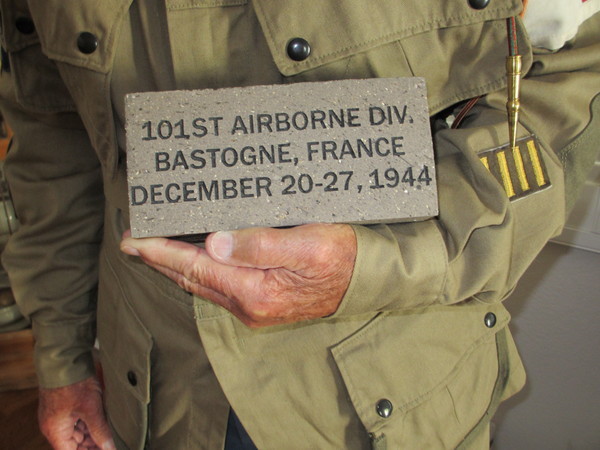
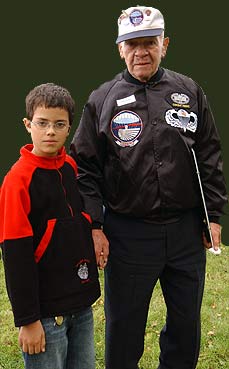
When referring to a Memorial Brick dedicated to his 101st Airborne Division
that was part of the Memorial Day Ceremonies at Veterans Park, he scowled
at the inscribed dates, Dec. 20-27, 1944.(below right)
"They’re trying to cheat us out of two days!" he quipped,
reminding that he had landed in the combat zone two days earlier.
Nothing compares to the unspeakable deprivation men like Jed endured in
WWII. They lives like a rat. Think about not being able to clean up, minor
things like no toilet paper.
And scant medical supplies.
Part of the irony of Bastogne was that a new shipment of uniforms, weapons,
ammunition, and supplies had failed to reach the 101st paratroopers before
they were ordered to Belgium by Allied Supreme Commander Dwight D. Eisenhower.
"Some guys went (into combat) with just a bayonet or a trench knife,"
Jed said. "That’s was it."
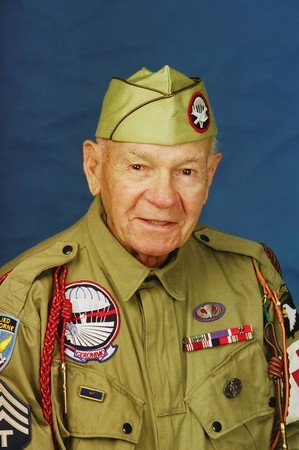
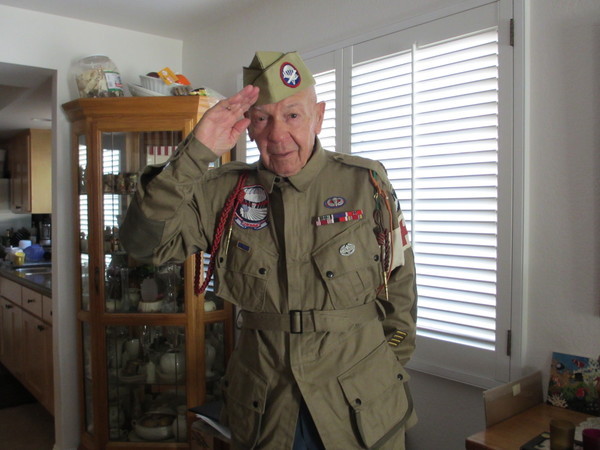
At the risk of a few more punch lines, let’s back up.
When asked where he was born, Jed says, "I was hatched." (Although he doesn’t smile, not even for pictures, you can tell the vet—who describes himself on his business card as "Proud to be a Battered Bastard of Bastogne"—enjoys playing to his audience.)
One of six children (two girls and four boys), Leon A. Jedziniak grew up in New Britain, Conn., "the Hardware City of the World," he said. "They made mess kits, toasters, electric stoves, you name it."
His father, a locksmith, emigrated from Krakow, Poland in 1910, as did his mother. “In fact, my oldest brother was born in Poland,” Jed said.
Drafted in 1943, Jed was the first of his four brothers to serve. The Army "held me back to send me to OCS (Officers Candidate School)," he said. His response: "Are you kidding? I never even finished high school!"
Tapped as a medic (he had no choice in the matter, he said), he trained for six months at New York’s Bellevue Hospital. Since the paratroopers "were short 15 medics," he volunteered.
Sent to England for parachute training, he graduated from jump school, receiving his gold jump wings on Dec. 3, 1943.
Jumping from C-47s (or "Gooney Birds,” as they were called), paratroopers carried 80-pound parachutes and 40 pounds of equipment, Jed said. They were taught to "scrounge" for whatever they needed—potatoes, turnips or anything else—once they hit the ground.
Trouble is, Jed never made a wartime jump. "I missed the Netherlands jump by four days," he said, referring to the largest airborne assault in history that took place in Holland.
Instead, stationed in Mourmelon, France with the 101st Airborne, he was told, "Saddle up, we’ve got to go to Bastogne."
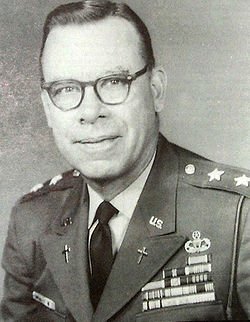
He saw action his first day when told to rescue a fallen comrade. Jed, a priest and another paratrooper were edging along a railroad track when they encounted a spray of machine gun fire from a lone German firing from a disabled tank.
"He
was firing at Father Sampson (left), myself and the kid," Jed said.
"The kid got hit in the arm, (but) Father Sampson and I dove over
the bank. The kid got back by himself."
Jed and the priest finally reached the fallen comrade, who was given the
last rites.
Then Father Sampson
and the young medic managed to get the deceased back to the aide station.
That’s when Father Sampson said to Jed, "I’m going to
put you in for a Silver Star."
Jed allowed a dramatic pause, his comic timing, as always, perfection.
"The next day, Father Sampson gets captured by the Germans."
Sgt. T-4 Jedziniak never got his Silver Star. "They gave me a bronze
one instead."
He saw Father Sampson again, however, 31 years later in Fort Benning,
Ga. Always the jokester, Jed tapped the priest on the shoulder and said,
"Father Sampson, are you still working on the railroad?"
Jed had to remind Sampson who he was. "So you’re the medic!"
the priest exclaimed. "I was wondering where the hell you were!"
How did Jed like being a medic? "I didn’t like it," he
said, scowling again. "Running around with a bedpan and a urinal?
Come on."
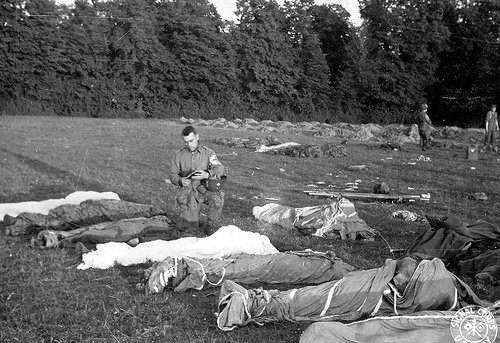
Jed treated the sick and wounded as best he could in a seminary and churches. "We had no hospital, no morphine," he explained. As for the fallen, bodies "were stacked up like cordwood" behind the aide stations, dog tags—then equipped with tooth notches—slammed up between the front teeth for later identification.
Since the Allies were based primarily outside the city, in the Ardennes
Forest, scrounging for food wasn’t easy.
On the one occasion Jed and some buddies located an abandoned farmhouse,
they discovered a Coleman stove, potatoes and Oleo Margarine. "We
had French fries until we ran out of gas," he said.
When the weather finally
broke, they heard the heavenly drone of U.S. C-47s.
"You’ve never seen anything like it, one hundred planes coming
over and dropping supplies," Jed said.
Not all were usable. "We got morphine syrettes (syringes) that we
couldn’t use because they were frozen," he explained. "You
build a fire and the mortars come in. We were surrounded."
Even when the Germans retreated and U.S. forces occupied their foxholes,
"they knew exactly where we were and put mortars in on us,"
Jed said.
The Germans issued an ultimatum to the Allied commander of Bastogne, General
Anthony McAuliffe, to surrender within two hours or face annihilation
from a massed German artillery bombardment.
They brought the dispatcher to McAuliffe’s headquarters blindfolded
and McAuliffe’s reply was "Nuts!"
German commanders asked what "Nuts!" meant. "Go to hell!"
was the reply.
"That story spread like wildfire," Jed said, and gave a "huge
boost" to the demoralized troops. The Germans didn’t realize
just how depleted the U.S. forces were, he added. "If they’d
hit us all at once, we would have been gone. All of us."
Instead, the U.S. prevailed, and the last great Nazi offensive of WWII
was over—although not officially.
Jed accompanied the 101st Airborne Division to Adolph Hitler's vacation
retreat in Berchtesgaden to hunt members of the Nazi leadership that had
gone into hiding. He saw combat continually for the next few weeks.
There were some high points of his service, such as running into his oldest
brother at Berchtesgaden, another brother in France, and another in Liverpool.
Someone asked Jed how the brothers made contact without cell phones. His
answer? "Brains."
By the end of January, he finally got his shower.
It was time to go home to Connecticut. Three years later he married his high school sweetheart, Florence, and they had one daughter, Karen.
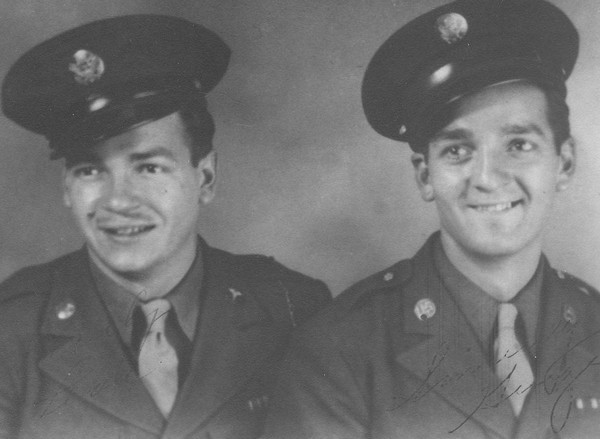
Jed worked a series of
jobs: prison guard, gas station owner and security guard among them. After
his wife died, he moved to Florida, where he spent 35 years. "I loved
it," he said. "I’ve had a good life."
It was only after his girlfriend passed away several years ago that he decided
to move to Redondo Beach. "My daughter has been trying to get me to move
here for 15 years," he said, remarking on how Karen Engle, a nurse who
recently retired from UCLA Medical Center, now works part-time at Torrance
Memorial.
Jed lives with Karen and her husband, David Engle, a professional photographer,
and two dogs, Goldie and Pilaf.
Some of his best times nowadays are spent at annual reunions with the few
remaining veterans of his generation. "We’re getting fewer and
fewer," he said. "We only had 13 guys show up last year in Kentucky."

(Rodondo Beach Patch)
Thank you Katherine.
