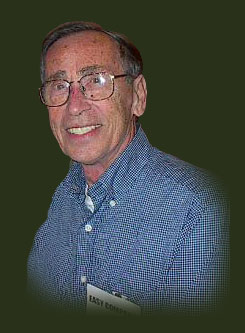
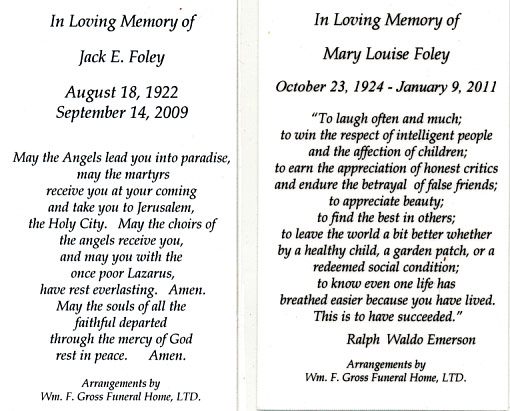
Jack E.
Foley came out of a solid middle class family and was one of three boys (the
middle one) He was born on August 18, 1922. Neither one of his parents attended
college. His mother, Viola Gertrude MEAHL, completed Catholic schooling, learned
to play the piano and was an accompanist in one of the Pittsburgh's silent
movie theatres. His father, a real Irishman, enjoyed singing, and Jack always
remembers the baby grand piano in their living room. Mother playing and father's
baritone voice. His father was a super salesman, working originally with the
U.S. Steel Company, in their Universal Atlas Cement division. In the early
30's he was recruited by the Pittsburgh Plate Glass Company (PPG) and took
over their Columbia Portland Cement Division. He traveled quite a bit (automobile)
and was relocated many times - from Eastern Ohio to Western Pennsylvania,
and back to central Ohio during WWII.
All
three children graduated from the university - Jim as a Veterinarian from
Ohio State University, Dick from Fresno, California and Jack from University
of Pittsburgh in September 1946 (Majored in Political Science & Economics)
Jim
was drafted right after graduating from Ohio State University, but he did
have time to take the State Boards in Ohio and Virginia before being called
up. By September 1942 his commission as a 1st Lt in the Veterinary Corps came
through. After WWII he remained in the Officers reserve Corps, went on Active
Duty and then completed his time in the Reserves, discharged as a full Colonel.
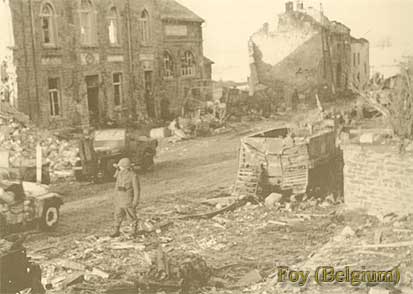
In the fall of 1939 JACK was a senior in South Hills High School and his first class was French, taught by Ms.White. He was responsible for providing an "update"on the war each morning. He was well aware of the German blitz-krieg, from Poland to the sea, then west through Denmark, then Belgium, Holland and France. During that year (1939) the US initiated a universal draft system and it was defined by age. In the Fall of 1941 a number of those "draftees", having completed their term were being discharged. But then, December 7, 1941 PEARL HARBOR changed all of that. A revised draft system was inaugurated but since, at that time, Jack was only 19 years old and he did not have to register. But May 18, 1942, when he learned of the fall of the Corregidor and the fall of the Philippines (and Gen.Mc Arthur's"I shall return") he joined the Enlisted Army Reserve. He thought that if he speeded up his courses at the University of Pittsburgh he could be graduated before going to Active Duty. However by June 1943 the war still had not changed for better (?), with the opportunity to go on Active Duty, even with only "summer school" remaining for graduation, he left for the Army at age 20!
He quickly made Corporal and became eligible (noncommissioned) for Officer Candidate School (OCS). By November 1943 he was a 2nd Lt. in the Coast Artillery Corps in charge of a 1918 three inch gun, guarding part of the Puget Sound at Ft. Worden WN., the most northern military post in the continental United States. However by the Spring of 1944, the military was becoming aggressive rather than defensive, and his unit was transferred to Texas where all Lieutenants were transferred and detached to the Infantry. By late May 1944, he was being trained in Infantry Tactics and became enamored with those C-47s flying overhead everyday discharging paratroopers into the blue sky. This was at Ft. Benning, GA. He immediately, upon graduation from the Infantry School applied and was accepted into the Parachute School. Eight weeks later he completed training. (7 sky drops, 7 night, 1 with full combat pack) He was ready for oversea shipment but he was hoping that shipment would be to the ETO rather than to the Pacific. As Jack told me: "Lucky me!, It was the ETO! with the full knowledge that all combat would be committed by General Ike and not, typically, by just an Army general!"
The best Jack liked about his training at the Parachute School was the rigorous physical training, administrated by the Sergeants. They were respected even though a slight so called"misdemeanor" would result in "take 25 push-ups". Or with a Jump called off because of sudden high winds and with "chutes still on, those Sergeants (knowing that they wanted that extra exercise!) would have them jog around Lawson Field (the Airport at Ft.Benning), a one hour run. They had a Captain in charge of their group. He was a veteran of the Aleutian Islands (Kiska & Attu) and already had been Purple Hearted via a Japanese bayonet. He was the leader on all their "runs", he never fell out, for when he drifted to the rear, there were always two men at the end who caught him and assisted him in completing that run. Even then there was strong camaraderie among the troops!
Before going to Europe Jack only knew geographically about Holland. Only later he understood that it was The Netherlands. He was aware of the lowlands but the dikes, names, locations of the cities told him nothing. Jack did not fight in Holland but he wrote me: "It was only later (still during WWII) that I learned about the deep seated love and generosity of your fellow countrymen."
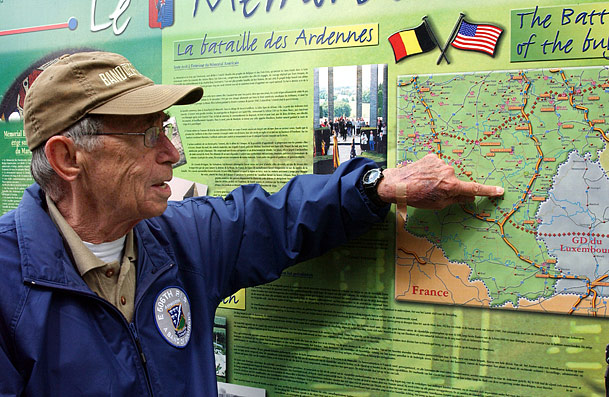
(R)
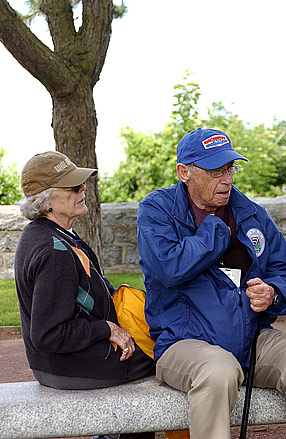
Jack Foley points out the village (Mande Ste.Etiénne) that he vividly
remembers from WWII.
This is what he told me:
" Why is this little village important - at least to me? And maybe
I'm the only one, or one of the few, who remembers that after that long
trip from Mourmelon, standing up on that crowded truck, checking and rechecking
those MPs, who for us, were the real American MPs, and their directions
were accurate. But with fellows who had jumped in Normandy and Holland,
here I was, a replacement officer, and so I joined them in their past
glory(!) in this little dot on the map - Mande St. Etiénne - night
time, crowded and pushing to get off, there I was, on the edge, carbine
in one hand, musette bag over my left shoulder, and I jumped! My first
and last night combat jump, altitude, not in km but in feet - all of perhaps
4 feet to the ground!
And
there was that large sign board, with all types of towns, roads, other data
identified, along with good old Mande! I have a good reason for having you taking
this picture AND for sending me a copy. Many many thanks."
After the War Jack came home with the 506th P.I.R. on the Queen Mary, and Capt. Ronald Speirs was the CO of the 1st Battalion Headquarters Company. He marched down 5t Avenue, New York City, January 12, 1946, the only Victory Parade the USA ever had!
After his 30 days leave Jack reported to Speirs in February at Ft.Bragg, NC. There he learned that the next morning he was to make his final Pay Jump in the Army. All his luggage was still at the train in Fayetteville, NC.... General Gavin, commander of the 82d AA, told all Officers at one of his meetings that they either had to sign up for an Indefinite Stay in the Army, or, they would be discharged as quickly as possible, according to their total points accumulated. Although Jack preferred to remain on duty until the end of May, Gavin's decree had him mustered out by mid-April 1946.
He went
home to Ohio for several weeks and then returned to Pittsburgh where he registered
for his final semester. He was graduated in September of 1946. Just imagine
that: Returning from the Second World War, having faced the Battle of Bastogne,
Germany, the concentration camps and the next thing you do is go back to school
as if nothing has happened !. While
he was in Pittsburgh he met a former girl friend from several years back and
they married on Thanksgiving Day 1947. He went to work in the Fall of
'46 with the Aluminum Cooking Utensil Company (subsidiary of Alcoa).
He worked
as a Sales Correspondent, Editor of a Company magazine, Sales Promotion Manager
for Westmorland Sterling Silver as well as Sales Promotion Manager for Alcoa
Wrap, household aluminum foil. From there he was transferred to the parent
company, Alcoa, where he was Advertising manager of aluminum closures (caps
for soft drink bottles as well as the snap-open cans for beer and beverage).
Jack
sometimes thinks back on the Army days, especially when viewing some of today's
movies. In all the films, including Band of Brothers, according to his opinion
the concentration camps are to artificial. He took a 35 mm film in a Concentration
Camp at the end of April 1945. He turned it in during early June of '45 and
all 36 color exposures were never returned to him by the Photography Section
set up the 560th Regiment. In that Concentration Camp he saw three barrels
in the middle of that camp. Each about 4 feet high and approximately 18 to
20 inches wide. One barrel contained spectacles (eyeglasses), another barrel
contained teeth, natural or artificial, especially those with metal fillings.
The third barrel was filled with hair. Jack: "Those three ugly containers
will never be forgotten."
Jack thinks it's great that Eindhoven and countries such as France, commemorate D-Day and their liberation annually. He said he was fortunate to be in Normandy on June 6, 2001, together with his wife and son David, to celebrate the honoring of D-Day with them. He thinks it is to bad a country like the USA has not seen to fit to honor those who died and/or fought in those wars and that the only great War Holidays are Memorial Day (May 30) and the Fourth of July. He thinks that unfortunately they all became too political. According to his opinion authors like Stephen Ambrose and Tom Brokaw have done much to glorify the soldier, regardless of rank. He thinks without those two primary writers many of their children, grandchildren and even their peers would be uninformed of the deeds, performed by what is now called the "Greatest Generation".
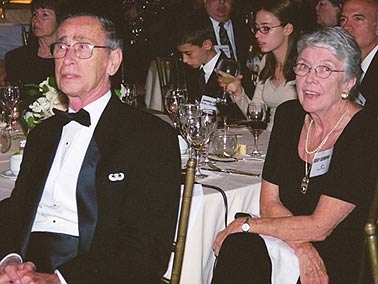
He received:
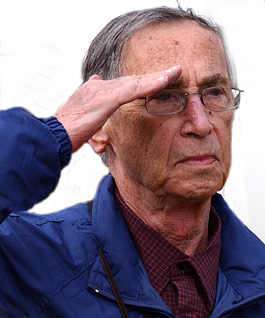
American Theatre, European Theatre with 3 stars, Bastogne, Rhineland, Central Europe, The Purple Heart, The Bronze Star, Victory, Occupation Combat Infantry badge, Parachute Jump Wings, The Presidential Unit Citation and the Belgian Croix de Guerre.
Use browser arrow to return
