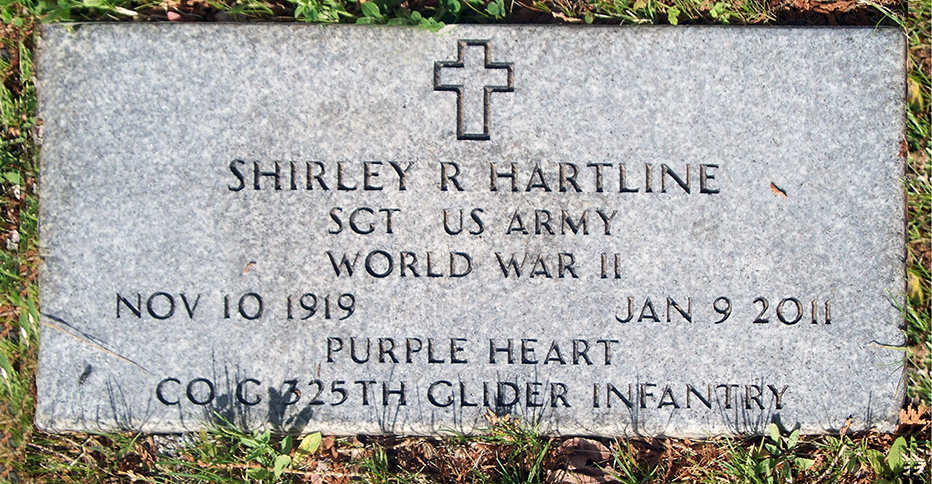
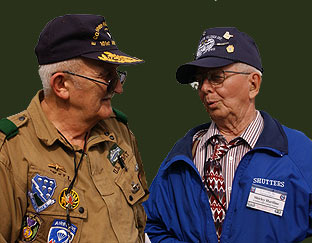
Mr. S. Hartline was a member of G Company, 325th glider Inf. Reg. 82nd A/B Division
He had
been sealed in camp at Camp Williams, a marshalling area and airfield fifteen
miles northeast of Exeter. The airfield was called Uppottery, taking it’s
name from nearby devonshire village.
The days before June 5th they spent doing the usual training, being issued
their equipment and rations they would need on landing.
June
5th:
They took part in studying maps of their landing and sand table models. After
lunch and toward evening they watched the paratroopers loading up. It took
the planes some time to form up after they had taken off. They went to bed
and tried to get some sleep which was hard to do, realizing that the planes
that would return would soon be pulling them in the gliders.
June
6th:
The paratroopers had been dropped and were meeting stiff resistance, the order
was received to commit the 325th Glider Inf. Regiment.
The planes had returned and were, together with the glider they would use
checked over and cleared to tow them in.
The glider they would use was the CGHA, which carried thirteen men, or a jeep
and four men crew and two pilots. Many of this type glider was made at Ford
Plant in Kingsford. The other was a much larger British glider, made of plywood,
carrying 28 troops and 2 pilots.
The gliders used in de war were much different than the sailplanes you see in use today. Some people refers to the ones used in the war as Silent Wings;They didn't’t make much noise but could not glide. They had to cut loose very near to the landing zone. The C-47’s towing them made a lot of noise.
Mr.
Hartline’s company was assigned to the Horsa’s.
D+1
June 7th:
They were awakened at 2:30 A.M., given a quick breakfast a half hour later.
They returned to their tents and hastily secured their equipment.
They were formed in their platoons and marched to the airfield and the glider
they were to ride in. Their glider was near the end of the formation, so they
knew they would be some of the last to land.
They had
a pretty good wait. Some of the conversation was about riding in the “flying
coffins” “tow targets”of “flack hacks”as the
gliders were so often called. One glider man wanted to know whether this trip
was really necessary.
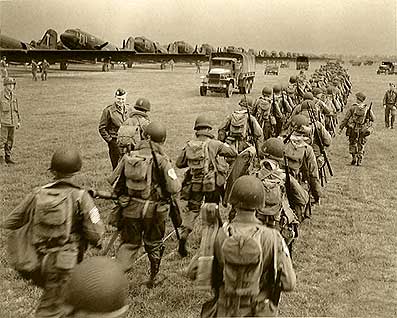
As the C-47’s began warming up, they were ordered to load the glider.
Everyone was assigned a seat. Our platoon leader, 2nd Lt. Robert Maxwell,
had the first seat on the right, behind the pilots. Mr. Hartline’s seat
was the first seat on the left. The portion his seat was attached to was reinforced
and could be lowered down to drive the jeeps in for loading. There was a wall
between the pilots and cargo space.
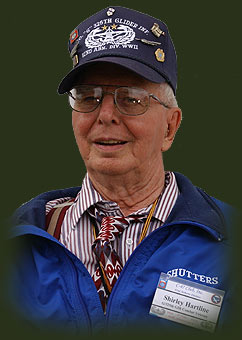
They were airborne around 6:30 A.M. and it took some time to get into formation and head towards France. They were escorted mostly by P-38’s and british spitfires. The Luftwaffe never made an appearance and flak was almost absent. They could look down and see ships in every direction for as far as they could see.
After
they passed over the coast Mr. Hartline awaked Lt. Maxwell and told him they
were over land. He stood up and was standing in the doorway between the pilots.
They flew about five or six miles inland, to near Chef du Pont, were their
landing zone was.
The larger field they had to land in was found to have been posted with large
posts. This made it necessary for them to land in the smaller fields. Since
they were in a glider near the end of the formation, they did not have much
choice of fields.
The glider
was cut loose and they landed, but the field was slightly slanted. The pilot
put on full brakes and full flaps. Due to the grass being wet from the dew,
it seamed like they gained speed.
Mr. Hartline thinks the pilot was trying to steer the glider between two large
trees in the hedgerow, but their right wing caught the wing of a glider that
had already hit the hedgerow. Lt.Maxwell was still standing in the doorway
and was killed by impact.
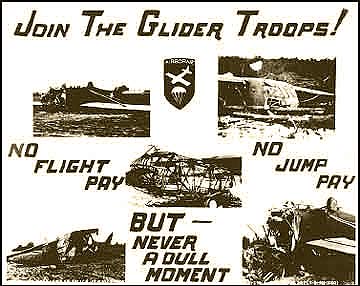
Mr. Hartline had tightened his seatbelt as tight as he could, put the butt of his rifle against the inside of his right foot and held the muzzle end of his rifle as hard as he could diagonally across his body toward the front of the glider, hoping this would clear the petition between him and the pilot out of the way. It must have done the job for he was still holding it that way when he came to on the other side of the hedgerow.
The pilot was still living and mr. Hartline gave him a shot of morphine. The co-pilot and the first eight on the right were killed.
Only 37
men out of a company of 128 were accounted for.
After the landing, they were ordered to assemble and they passed through Chef
du Pont. They made no contact with the enemy for they had landed in the forward
lines of the 4th Division. This division had received light resistance on
Utah Beach. They formed a bivouac in an orchard for supper.
Mr. Hartline
was bruised from the landing, and probably had a concussion, for his nose
started bleeding on the march to the orchard. He had the skin of his right
hip broken in a fair size area and went to the Aid station to get it taken
care of before the Medic could get to him. They were told to return to their
company. They told them to fix Bayonet, for they were to go on a night attack.
They searched all night but didn’t contact the Germans.
June 8, 1944:
They had more of the men from the Company join them and tried to get some
rest. At 23.00 hour they were ordered to move out at midnight and move north,
closer to Fresville.
June
9th.1944
They were ordered to attack at 04:00. The Battalion’s object was Le
Ham. To get there they had to cross the La Fiere Causeway. The Third Battalion
had the main attack on the Causeway. They were to their left to protect the
left flank. They advanced up a hill to a hedgerow. There was a set of steps
built to get over the hedgerow and they were ordered to get over them. Hartline
was the fourth or fifth man to cross the steps. On the other side, the hill
sloped away. They were exposed to the germans in the next hedgerow. They turned
to their right and headed for the hedgerow. Hartline had only gone ten to
fifteen feet when a mortar shell hit on line between him
and his comrade. Hartman must have hit the ground before it landed. He got
up and jumped the crater while the smoke was still rising.
He made
it to the end of the field, where there was an 8 to 10 foot drop. He did not
hesitate to jump. His comrade that was ahead of him said: “How did you
get there. I thought that shell got you.” They moved to the next field
and advanced only a short way when machine gun fire, mortar and 88,s came
in on them in very concentrated fire.
Their company commander, Captain Irvin Bloom was killed along with many of
their comrades.
Hartline
was pinned down. Finally a mortar shell hit on the top of a tree he was laying
under and he was hit by shrapnel in his right leg and foot. He took the sulfa
pills supplied for if hit and bandaged his wounds. They were under heavy barrages
for three hours or more. After dark, two soldiers from the 505th paratroopers helped
him back to the field aide station. When he woke up the next morning and looked
around most of the troops there were from his company.
At dusk the night of the 10th of June, they were loaded on six-by-six trucks.
There were nine stretchers loaded on the seat level,
and nine across the side boards on top.
When
finally eased up he tried to make his way to the rear. He crawled back of
the hedgerow until he came to a French farmhouse. They motioned him to get
into the house which he did not know whether any germans were in or not. They
assured him there wasn’t any. They were a very old couple. He was minus
a leg from WW One and a brother had his hand amputated, probably from WW I.
The lady fixed him an egg with bread and gave him a glass of wine. Then he
was given a glass with a clear liquid in it which he drank, but had a hard
time getting his breath. That was his first introduction to Calvados.
They had just arrived at the Landing Craft they were
to load them on to be taken to the hospital ship when all the aids hit the
ground A German plane flew at low altitude along the line of landing crafts
being loaded. No one was hit. The medics had given the pilot the name “Bed
check Charlie” because the plane made the pass over at the same time every
night.
The next
morning, when they awoke. They found the L.S.T. they were on was sitting on
the sand waiting for the tide to come in. It was an hour or so before they
were afloat and they took them out to a hospital ship which we were put aboard.
They landed at Southampton and were taken by train to the 55th General Hospital,
Malvern on the Green, Wells. There were four general Hospitals in this area.
When they were well enough they visited some of their comrades in the other
hospitals, one being 1st sergeant Daniel L. Abner from Kentucky. He was later
killed in action in Holland.
Having recovered good enough they were returned to the 325th Glider Infantry
at leicester, England to prepare for the next operation, which was the Holland
invasion.
G. Co. After
31 consecutive days of combat, without any replacement, it was finally relieved.
There was an Officer and five enlisted men left.
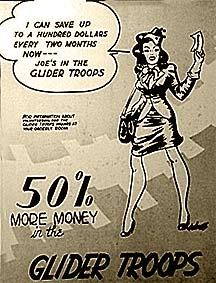

The 325th Glider Infantry was awarded The presidential Unit Citation for this operation.(r)
FACTS
Invasion of France, June
1944
Scheduled to tow 514 gliders, of which 292 GC-4A's
and 222 Horsa's in six glider operations on D-Day (June 6) and D+1(June 7)
near Hiesville (10 miles inland from the Channel coast) and
Saint-Mère-Eglise June 6, 1944
Operation Chicago : 101
AB/434 TCG, 52 GC-4A's landed at 03.45 hrs. and delivered 155 troops, 16
anti-tank guns, 2 _ tons of ammunition, 25 vehicles and 1
bulldozer.
Operation Detroit : 82
AB/437 TCG, 52 GC-4A's landed at 04.10 hrs. and delivered 220 troops,
22Jeeps, 18 anti-tank guns, 10 tons of supplies and 5
trailers.
Operation Elmira (1st wave)
: 82AB landed in two serials, each consisting of 8 GC-4A's/18 Horsa's
of 434 TCG and 14GC-4A's/36 Horsa's of 438 TCG respectively at 21.04 and
21.37 hrs. Both serials carrying 437 troops, 64 vehicles, 13 anti-tank
guns and 24 _ tons of supplies.
Elmira (2nd wave) : 82
AB landed in two serials to supply artillery. In the 1st serial 2
GC-4A's/48 Horsa's of 436 TCG were down at 22.55 hrs and delivered 418
troops, 31 jeeps, 26 tons of ammunition and 25 tons of supplies.
In
the 2nd serial 12 GC-4A's/38 Horsa's of 435 TCG were to land at 23.03 hrs.
to deliver 319 troops, 12 howitzers, 28 jeeps, 33 tons of ammo, 23 tons of
supplies each GC-4A carried a howitzer.
Operation Market
the Netherlands (US/UK)
September 17, 1944
101AB 437 TCG, 70 GC-4A's landed at 13.48 at LZ-W, unloading 43 jeeps, 18
trailers, 311 troops, Signals unit, Recce platoon, Medical Coy
82 AB 439 TCG, 50 GC-4A's landed at 13.47 at LZ-N, unloading anti-tank battery
8 x 57 mm guns, 9 jeeps, 2 trailers
1st Airborne anti tank battery (British forces) : 7 GC-4A's landed on LZ-N,
three on LZ-Z
September 18
101 AB 434, 435, 436, 437, 438, 442 TCG towing 450 GC-4A's to LZ-W, transporting
2656 troopers of 327 GIR, 326 Eng, 326 Medic, including Brg. Gen McAulliffe
82AB 61, 313, 316, 439, 440, 441 TCG towing 454 GC-4A's to LZ N & T, landing
at 14.31. 1899 troopers, 206 jeeps, 123 trailers, 60 guns of the 319, 320and
456 Field Artillery, 80th anti-tank batt and HQ Div. Artillery
September 19
101 AB (TCG see Sept.18) towing 385 GC-4A's to LZ-W with 81 Anti Tank Bn,
321 Glider Fld Art., 327 Glider Field Regt, 377 Para Field Arty, Div. HQ Arty
September 20
82 AB 53 TCW 1 GC-4A to LZ-O with 1 _ tons supplies at Nijmegen
September 23
101 AB 436 & 438 TCG towing 84 GC-4A's to LZ-W, with 395 troopers, 1200
tons supplies, 15 guns, 13 trailers, 23 jeeps
82 AB 61, 313, 316, 434 TCG towing 406 GC-4A's to LZ-O with 325 GIR, 80th
AB Anti tank bn, MP platoon, Recce platoon, two companies engineers.