He published his interview in the 'Meteor-Heraut'.
Below his article. I appreciate it that Rick gave me permission to use it for my web site.
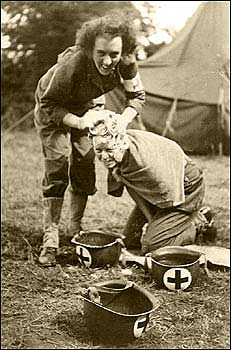
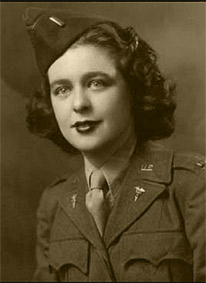
As told by Kate Nolan, 53rd Field Hospital.
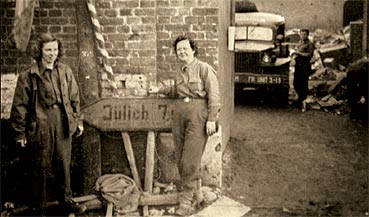
"I was in from Aug. 6, 1943 until March 1946. We had to be registered nurses. When they'd get enough people, they'd put us through basic training. We trained at Fort Bragg and went to England where we had intensive physical training, 10-miles hikes, three times a week, with full packs. Up hill and down dale and rains and everything. We needed stamina because of the long hours en de living conditions. We were in tents pretty much all the time. Shortly after D-Day we landed at Utah Beach and after St.Lo we were with the 3rd Army. We went from Brittany to the Ardennes, the Battle of the Bulge, and Central Europe and to the Rhineland. We did not have helicopters so the field hospitals had to be within 5 miles from the front. Usually we were closer.
Her brother found a German burp gun and accidentally shot her. They brought her to us and of course, we couldn't turn her down. So the surgical teams went to work and she was such a brave little thing. We had one Dutch young man that came in and he was really great with Tina.
He gave her a lot of attention. But we had her for two weeks and the we got orders to go into Germany, so we had to take her back to Maastricht to a hospital there. They had no supplies. We took what we could spare, penicillin and morphine and bandages and IV tubes. But our Dutch friend, told us that she died about three weeks later. It affected all of us, because we believed that if we could have kept her, she would have lived. It's very satisfying to know that we were able to save so many lives,
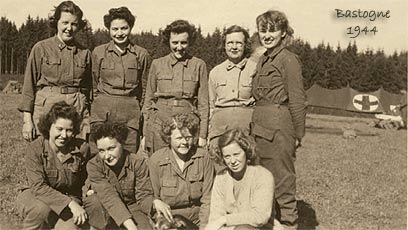
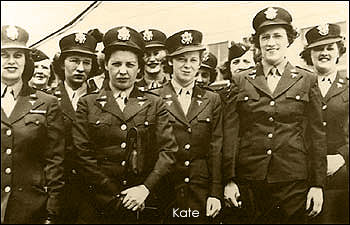
Kate Nolan (lower right) with 5 other nurses from 3rd Platoon 53rd Field Hospital and 3 nurses from the surgical group. Near Bastogne 1944.
because 95 percent of the seriously wounded they were able to get to the field hospitals survived. The surgeons who operated on them and their whole surgical
teams came from the best medical centers in the country, Johns Hopkins and the Mayo Clinic and Massachusetts General and that caliber of institutions. And we had the penicillin. We had a lot of things going for us."
What do you think of the people in today's Army?
"I think they are wonderful and it's hard for them to go in the service. You know, in WWII we had the whole country behind us. This war they don't know who's for them, even in their own country. There are so many enemies. It's a very strange situations."
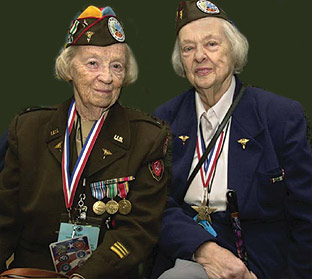
Rose Young, 130th General Hospital (R)
"I
reported for duty Sept. 3, 1943. We where the whiz nurses because when we
went in there, they were forming a unit. I had enlisted in New York City and
we were shipped down to Cam Rucker, Ala. We were waiting for the nurses' basic
training course but there was a hurry call for the unit, so the gave us a
little brief with our own enlisted men instead in the basic training course.
Then they shipped us up to Boston and we landed in England on Dec. 3.
We set up a hospital that was a special unit to treat and research combat
fatigue, and that's what we did in England. They sent us down to Dover to
wait in line to go across, and I went to the continent the first week in August.
Our personal were on the Leopoldville, and our equipment was on another
ship, and the other ship was sunk. We landed in Normandy with no equipment.
So we stayed in tents just behind the beach and we were daily shipped to other
hospital units to just help out. And then at night they'd bring us back to
our cow pasture in Normandy.
There were 83 women in our group because we were a general hospital which
is the biggest hospital unit you can have. We than moved to Ciney, Belgium,
and that's where I stayed at the rest of the time. I was in Ciney when the
Bulge started. They emptied most of the wards and evacuated most of the help
that weren't needed. They
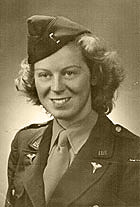
Kate
Flynn Nolan (L) and Rose Young
foto:
Rick Haverinen
My honest thing is that the soldiers of that time, and especially the ones that fought in the Bulge, had a closer contact with the female nurse, because we were all much closer to combat. And I think to this day these men show us the greatest respect."
Are there particular faces you remember?
"I try not to because I had several boys that were on standby beside me when I was working on the ones coming in that were severely wounded. The corpsmen kept nursing, cleaning them and so forth, but my main job with those boys was to just keep talking to them. As I was working on others, I would call them by name and kind of chatter with them, you know, because we knew that they were not going to make it. We you have to give that. It's not part of your job, but part of your being, to give them that support. Sometimes they would think you were their mother our someone, and it became a very intimate, personal thing to talk to these kids when they were hurting. We weren't much older than they were, but we had the job of being supportive of them.
What mark has your generation left on the world?
"We're getting cliche, but I think we were good examples to the generations to come afterwards, because we came from the Depression, into a war, and then were offered our education. So we were given a way to develop ourselves that maybe no other generation has had. I was sent home on leave when the (atomic) bomb was dropped. They extended our leaves and then finally they sent our discharges. They wanted to get nurses into civilian life because there was a shortage. I married and had three children. And most of the time during their growing years I was night supervisor in a small private hospital in New York City."

I don not intend to infringe on any copyrights.I just want to promote Band of Brothers© and pay a tribute to everyone who was involved in giving back our freedom in wwII
